B-21 Radar: Increased Production by 25% Accelerates the Establishment of a Strategic Bomber Fleet
The United States Air Force, in cooperation with Northrop Grumman, has decided to significantly expand the production capacity of the B-21 Raider stealth bomber. The B-21, which began low-rate production in 2024, is now transitioning to full-scale production and is becoming a core component of the United States’ strategic air power restructuring. This production expansion reflects the United States’ long-term military strategy to counter potential adversaries with advanced air defense systems.
Production increase of 25% and specific plans
According to a contract signed on February 23, 2026, between the U.S. Air Force and Northrop Grumman, the two parties agreed to increase annual production capacity by approximately 25%. This will be achieved using existing funds of $4,500,000,000 allocated in the “One Big Beautiful Bill,” a proposed amendment to the 2025 fiscal year defense budget. The B-21, currently being produced at Air Force Plant 42 in Palmdale, California, will undergo flight testing and is scheduled to be deployed to Ellsworth Air Force Base in South Dakota for its first operational deployment in 2027.
Currently, under the B-21’s production structure, the full production capacity is estimated to be approximately 7 units per year. This 25% expansion aims to shorten the delivery schedule while maintaining the current levels of cost and performance management.
B-21: Role and technical specifications
The B-21 is a nuclear-capable stealth bomber designed to replace the B-1B Lancer and the B-2 Spirit. It is equipped with advanced stealth technology and networking capabilities, enabling it to perform both conventional and nuclear missions, and is designed to be survivable in advanced air defense environments.
According to technical specifications, the B-21’s wingspan is approximately 43 meters, and its fuselage length is approximately 17 meters. It operates at high-subsonic speeds of Mach 0.8 or below. While it has a flying-wing configuration similar to the B-2, it features more advanced stealth design, a twin-wheel landing gear, and improved engine inlets. Furthermore, it incorporates artificial intelligence-based advanced technologies that significantly enhance mission planning and sensor fusion capabilities.
United States Strategic Bomber Fleet Restructuring
The United States Air Force’s minimum goal is to acquire at least 100 B-21 aircraft. Northrop Grumman CEO Kathy Warden stated in early 2024 that the B-21 program is transitioning to the production phase, and that the flight test results have exceeded expectations. After the first successful flight in November 2023, two test aircraft are currently undergoing flight envelope expansion testing and training for operational deployment at Edwards Air Force Base.
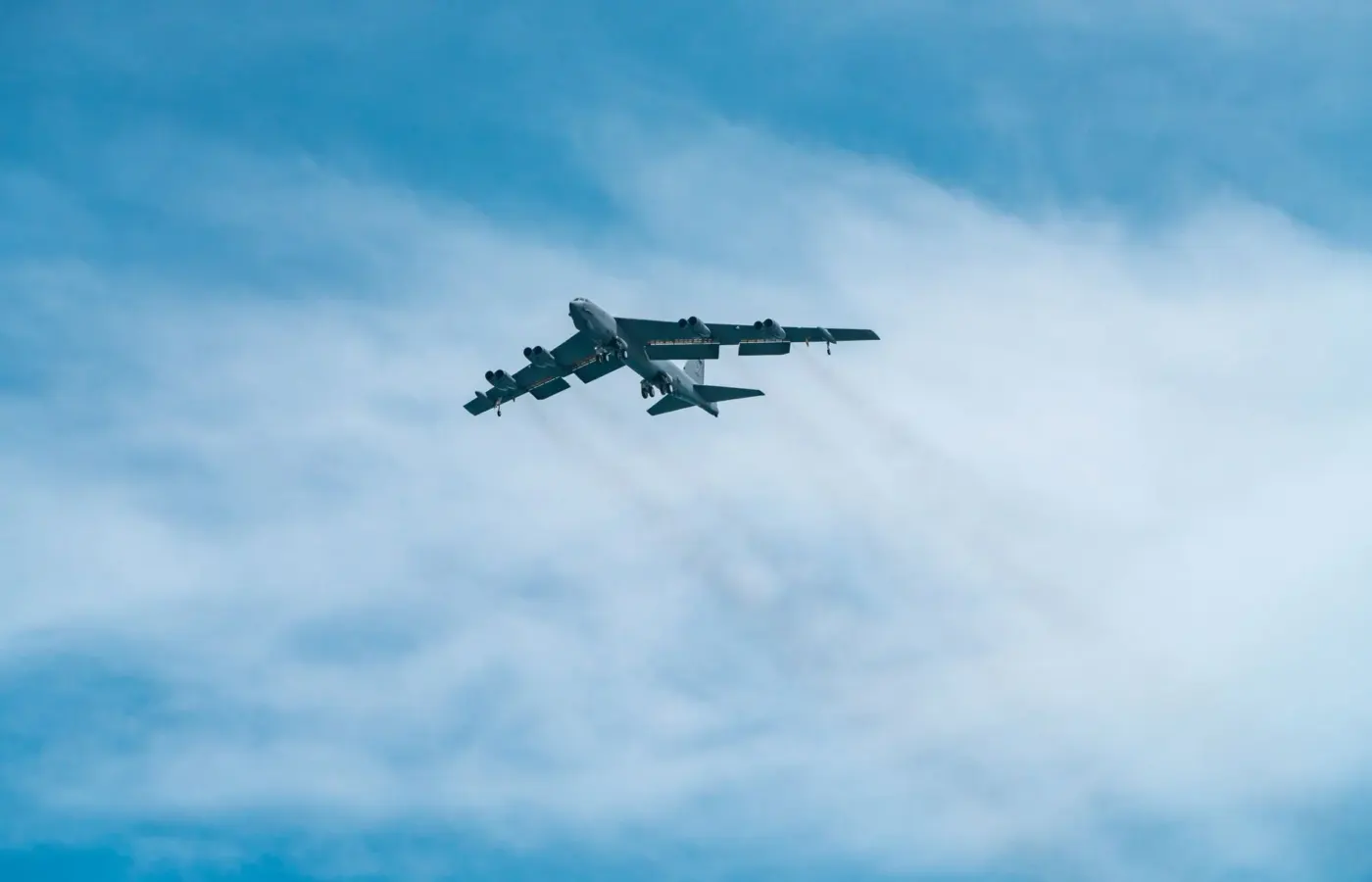
The B-21 is expected to operate alongside the B-52 Stratofortress, continuously modernizing the United States’ fleet of strategic bombers.
Impact on the defense industry and economy
The increased production of the B-21 will have an immediate economic impact on the defense industry. Northrop Grumman and its partner companies are strengthening their manufacturing capabilities to respond to the increase in production volume, and the Palmdale facility is working to improve production efficiency by utilizing digital engineering and advanced manufacturing techniques. Major defense industry partners such as Pratt & Whitney, Collins Aerospace, and BAE Systems will also have the opportunity to invest in hiring new personnel and developing new technologies.
Regional Security and International Influence
The full deployment of the B-21 is expected to have a significant impact on the security balance in the Indo-Pacific region. With a range of over 4,000 kilometers and the ability to be refueled in the air, the B-21 provides the United States with the capability to deliver rapid and precise strikes against targets of its choosing. At the same time, there is a possibility that neighboring countries may perceive this increase in military power as a threat to themselves, so there is a need for the United States to maintain regional stability through diplomatic channels.
Development and deployment schedule
The B-21 program gained momentum in 2015 when Northrop Grumman secured the contract for the development of the Long Range Strike Bomber (LRS-B). After its official unveiling in December 2022, the aircraft successfully completed its first flight in November 2023, and a full-scale production contract was signed in January 2024. While the initial operational capability (IOC) was originally targeted for 2027, the possibility of accelerating the development schedule is being considered due to the faster-than-expected progress in flight testing.
Frequently Asked Questions (FAQ)
Q. How does the B-21 Raider differ from the existing B-2 bomber?
The B-21 is smaller than the B-2, features a modernized design, and its acquisition and operational costs are reduced to approximately 1/4 of the B-2’s costs. Furthermore, it is equipped with artificial intelligence-based technologies and advanced networking capabilities, allowing for more effective operation in complex operational environments.
Q. When is the B-21 scheduled for operational deployment?
A. The first B-21 to be deployed for actual use is scheduled to arrive at Ellsworth Air Force Base in South Dakota in 2027. Subsequently, it is planned to be deployed to Whiteman Air Force Base in Missouri and Dyess Air Force Base in Texas.
Q. Can the B-21 be equipped with nuclear weapons?
A. That is correct. The B-21 is designed as a dual-capable strategic bomber capable of carrying not only conventional weapons but also nuclear weapons. As it is intended to replace the B-2 Spirit, it plays a crucial role in maintaining the United States’ nuclear deterrence.
Q. What is the increase in the number of B-21 bombers resulting from the 25% production increase?
A. While the exact annual production volume is classified information, the current planned production capacity is approximately 7 units per year. Therefore, a 25% increase indicates an expansion of production capacity. The ultimate goal is to secure a minimum of 100 B-21 aircraft.
Q. Where does the funding for the expansion of B-21 production come from?
A. The contract signed in February 2026 utilizes the existing 4,500,000,000 US dollars allocated in the proposed adjustments to the 2025 fiscal year defense budget to expand production capacity. This means the efficient use of already approved funds, not the allocation of new additional funds.
Q. What is the B-21’s range?
The B-21 is designed to fly over 4,000 kilometers without aerial refueling, and with aerial refueling, it is capable of performing missions worldwide. This means it can take off from the United States mainland and strike targets at long distances.