- The AH-64E is more like an “enhanced Apache” than a completely new helicopter.
- Why is the combination of Apache helicopters and unmanned aerial vehicles (UAVs) important now?
- The difference in the AH-64E lies in its ability to see farther and act first.
- As performance improves, the associated costs of communication and maintenance also increase.
- Under what circumstances would selecting the AH-64E be a worthwhile decision for a military force?
- Frequently Asked Questions.
If attack helicopters can see their targets without getting close to enemy territory, the way combat is conducted can change. This is one of the reasons why the AH-64E Apache Guardian is receiving so much attention.
So, how much of a difference will the AH-64E’s unmanned aerial vehicle integration make in actual combat compared to the existing AH-64D? The key is this:
The question is whether the costs and burdens associated with acquiring that capability are truly worth it.
The AH-64E is more like an “enhanced Apache” than a completely new helicopter.
The AH-64E is not a helicopter with a completely new design, but rather a significantly improved version of the AH-64D. In the past, it was known as the AH-64D Block III.
The key change is the ability to exchange information with unmanned aerial vehicles. By incorporating a digital communication system and unmanned aircraft control functions, the Apache has transformed from a standalone reconnaissance and fire platform into a combat system that can be connected to multiple sensors.
The U.S. Army describes the AH-64E as the latest evolution of the Apache helicopter. A key feature is its open architecture, which allows for the continued integration of communications, navigation, sensors, and weapons systems.
The basic specifications are a crew of two and a maximum operating weight of 23,000 pounds. The maximum level speed is 150 knots or more, and it can carry 16 Hellfire missiles, 76 rockets, and 1,200 rounds of 30 mm autocannon ammunition.
However, the key issue is not the quantity of weapons.
The essence of the AH-64E lies in its ability to integrate unmanned aerial vehicles, ground sensors, and communication networks into a single system.
Why is the combination of Apache helicopters and unmanned aerial vehicles (UAVs) important now?
In a battlefield filled with unmanned aerial vehicles, the moment an attack helicopter appears to search for its target, the risk increases significantly. Whether it can identify and engage targets from a distance determines its survival and the success of its mission.
Recent tests show that this interest is not merely publicity. In September 2025, the U.S. Army conducted a demonstration in which it used an AH-64E to detect and track a drone, then destroyed it with Hellfire and JAGM missiles, APKWS guided rockets, and a 30mm cannon.
During the European theater training exercise, data transmitted by the AN/MPQ-64 Sentinel radar on the ground was received by the AH-64E, which then tracked and engaged unmanned aerial vehicle targets. This involved not only using the Apache’s own sensors but also utilizing information from a distant sensor in combat.
There have been even more surprising developments. On February 26, 2026, an experiment was conducted to directly launch an A700 unmanned aerial vehicle from an AH-64E helicopter.
The scope of Apache’s capabilities is expanding beyond simply receiving video feeds from unmanned aerial vehicles or controlling flight paths; it is now moving towards deploying unmanned systems in the battlefield.
Now, they are a team.
The difference in the AH-64E lies in its ability to see farther and act first.
In a single sentence, the AH-64E is not a helicopter that replaces unmanned aerial vehicles. It is a helicopter that utilizes unmanned aerial vehicles as forward reconnaissance and target designation tools, thereby expanding the crew’s detection range and combat options.
The AH-64E’s MUM-T Level 4 feature allows the crew to receive video feeds from unmanned aerial vehicles (UAVs) in the cockpit. The crew can also control the UAV’s sensors and flight path.
For example, suppose there is an area that can only be seen by moving directly forward. In this case, an unmanned aerial vehicle can be sent first to obtain video, its flight path can be changed in the necessary direction, and the target can be identified based on that information.
Reconnoiter first, then go in.
This method offers advantages beyond simply expanding the field of view. It allows the Apache to choose whether to directly enter a dangerous area, pass target information to other weapons or sensors, or postpone engagement.
The AH-64E V6 includes Link 16, improved target acquisition and night vision equipment, a 3rd generation daylight sensor, and the MUMT-X software. This configuration supports not only the reception of unmanned aerial vehicle video but also the control of sensors and flight paths.
In the 2020 exercise, the AH-64E, RQ-7 Shadow, and MQ-1C Gray Eagle operated together. The fact that these three aircraft systems conducted cooperative combat operations demonstrates that the Apache can be used as a hub for connecting battlefield information, rather than solely as an attack platform.
The aircraft’s performance has also been improved. The AH-64E has a maximum speed of 164 knots, an increase from 145 knots for the AH-64D. The maximum gross weight has also increased from 20,260 pounds to 23,000 pounds.
Simply increasing speed and cargo capacity does not automatically lead to seamless integration of unmanned aerial vehicles. However, it does provide the foundation for unmanned aerial vehicle collaboration by enabling the transport of more equipment and information.
As performance improves, the associated costs of communication and maintenance also increase.
It is misleading to understand the AH-64E as an unmanned attack helicopter. Its publicly disclosed core capabilities include receiving video feeds from unmanned aerial vehicles and controlling their sensors and flight paths, which is different from fully autonomous operation.
MUM-T Level 4 differs from Level 5, which controls the takeoff and landing of unmanned aerial vehicles. Therefore, the idea that the AH-64E is an all-purpose command center capable of freely launching and recovering unmanned aerial vehicles is not accurate.
The biggest weakness is communication.
If the communication, navigation, and command and control systems are disrupted or jammed, the video feed and control functions of the unmanned aerial vehicle may be limited. If the detection range and target information that were intended to be obtained by using the unmanned aerial vehicle are lost, the crew may have to directly approach the dangerous area again.
The operational burden cannot be ignored. The existence of the unmanned aerial vehicle itself is necessary, and personnel and training are also required to operate it.
It was also revealed that performance improvements do not automatically guarantee operational readiness. On October 2, 2026, the U.S. Army issued a temporary flight suspension for AH-64E helicopters equipped with the improved transmission system, instructing that inspections and corrective actions be completed before flight operations resume.
This case does not invalidate the overall value of the AH-64E. However, it demonstrates that the more complex a system is, the more its component inspection and maintenance systems become an integral part of its combat effectiveness.
Ultimately, the weakness of the AH-64E is not its limited unmanned aerial vehicle (UAV) integration capability. The proper utilization of that capability requires a comprehensive system, including a communication network, supporting UAVs, trained personnel, and maintenance capability.
If the connection is lost, the advantages are also reduced.
Under what circumstances would selecting the AH-64E be a worthwhile decision for a military force?
If a unit operates unmanned aerial vehicles, ground sensors, and a reliable communications network together, the advantages of the AH-64E are fully realized. In this case, the AH-64E becomes more than just an attack helicopter; it serves as a platform linking forward sensors with fire.
On the other hand, if Apache helicopters are to be operated independently or in environments with a high potential for communication disruption, the order of priorities should be reversed. Before considering sensor and weapon performance, the resilience of the data link and the maintenance system should be assessed first.
- When unmanned aerial vehicles and ground-based radar systems operate together, the value of MUM-T (Multi-mission Unmanned Tactical Transport) and Link 16 increases.
- If communication disruptions are frequent, it is necessary to determine the tasks that must be performed even after the connection is lost.
- The number of unmanned aerial vehicles (UAVs) acquired and the level of training for personnel are just as important as the performance of the aircraft itself.
- The operational rates of the transmission and maintenance systems determine the actual combat effectiveness.
The AH-64E V6.5 was developed with an emphasis on enhancing its open system interface and Link 16 capabilities. Therefore, it provides a more advantageous foundation than the AH-64D for integrating sensors, weapons, and unmanned systems in the future.
However, an open architecture does not solve all problems. The actual effectiveness depends on which unmanned aerial vehicles, sensors, and communication networks are connected.
The conclusion is clear.
In a battlefield environment with a well-established network, the AH-64E has a distinct advantage over the AH-64D. However, if a unit has a weak network infrastructure, the difference in performance may be less significant than expected.
Therefore, the selection criteria should not be simply “which is the most modern.” First, we must ask whether we have secured a sufficient number of unmanned aerial vehicles, whether they can operate even if communication is lost, and whether maintenance and training are in place.
Frequently Asked Questions.
Q. Is the AH-64E always stronger than the AH-64D, even without the use of unmanned aerial vehicles?
A. While the speed, maximum total weight, and communication/sensor systems have been improved, the significant benefits of unmanned aerial vehicle integration emerge when support unmanned aerial vehicles and a network are available.
In standalone operations, the differences may be reduced.
Q. Does the MUM-T Level 4 feature enable fully autonomous operation of the unmanned aircraft?
A. No.
The core functions are receiving video from unmanned aerial vehicles (UAVs) and controlling sensors and flight paths. This is different from Level 5, which controls the UAV’s takeoff and landing.
Q. Does the AH-64E become useless if communication is lost?
A. The features of the unmanned aerial vehicle, including video and remote control, may be limited.
However, the key issue is not whether the AH-64E becomes useless, but rather how well it is prepared to continue its mission after communication is lost.
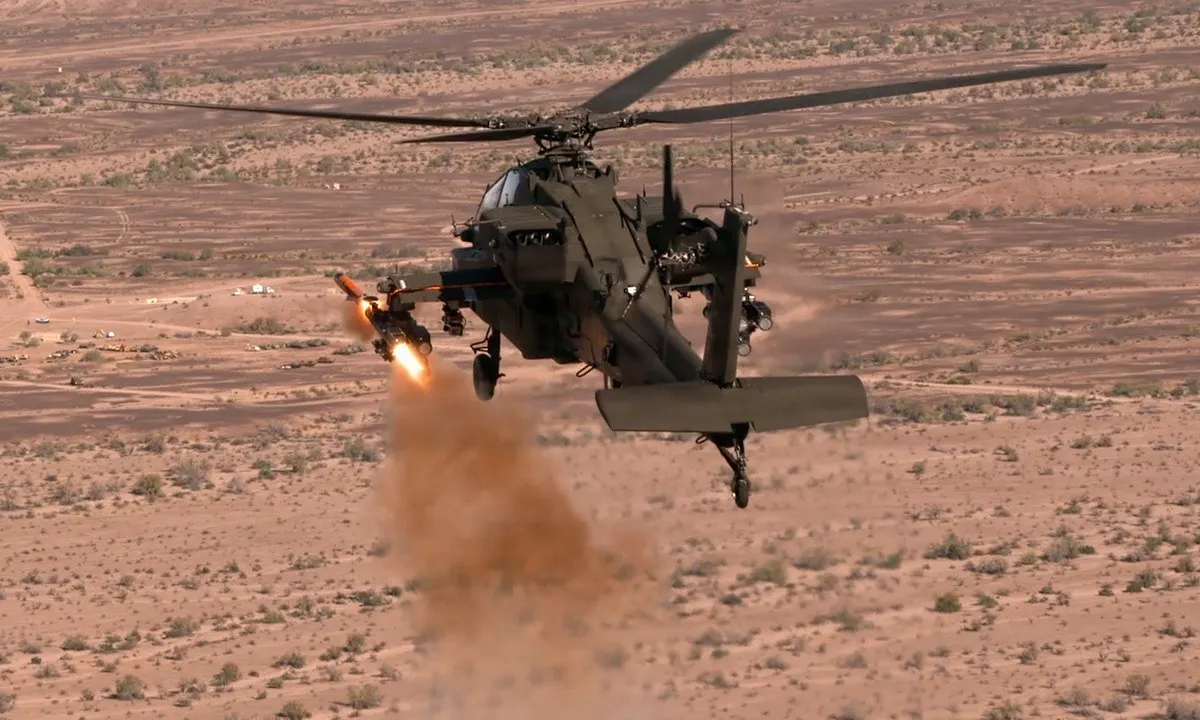
Representative photo — U.S. Army publicly released material
This is a work of the U.S. federal government (public domain). The use of visual materials from the U.S. Department of Defense does not imply endorsement by the Department of Defense.