- This is not an exhibition model; it is a warship currently under construction.
- After the F126 program was suspended, the number of ships increased from 4 to 8.
- Focus anti-submarine warfare capabilities on a small hull.
- Instead of gaining speed, its scalability was reduced.
- It is necessary to distinguish between estimated values obtained from equipment and models.
- The actual test platforms will be delivered in 2029.
- Frequently Asked Questions.
- Questions
- Questions
- Questions
- Questions
- Questions
- Questions
This is not an exhibition model; it is a warship currently under construction.
The miniature models displayed at the exhibition appear to be futuristic concepts. However, the F128, officially named MEKO A-200 DEU, is not a simple promotional design. Germany is actually planning to procure 8 of these vessels.
The first two ships are already under construction. The delivery date for the lead ship to the German Navy is also scheduled for the end of 2029. This means that the model is backed by a contract and construction schedule.
The model may be small, but the business is real.
After the F126 program was suspended, the number of ships increased from 4 to 8.
The plan to introduce the MEKO A-200 DEU began in August 2025. According to the German Federal Armed Forces, the keel-laying of the first vessel took place in May 2026. The initial concept was to deploy a temporary military capability of four vessels to fill the anti-submarine warfare gap while waiting for the delayed F126 escort ships.
However, the situation changed when the F126 project ended on June 24, 2026. The required number of F128 ships for the German Navy increased to 8. TKMS announced on November 17, 2026, that it had signed an additional contract with the Bundeswehr Equipment, Information Technology and In-Service Support Agency (BAAINBw) for 4 more ships.
This marks the moment when temporary military capability became the main program.
German naval inspector general Jan Christian Kaack stated, “We need steel in the water, quickly and precisely specialized in the capability of submarine hunting.” This means that a vessel is needed that can operate effectively on the surface and is specifically designed for hunting submarines. Germany prioritized schedule and mission objectives over waiting for a new design.
Focus anti-submarine warfare capabilities on a small hull.
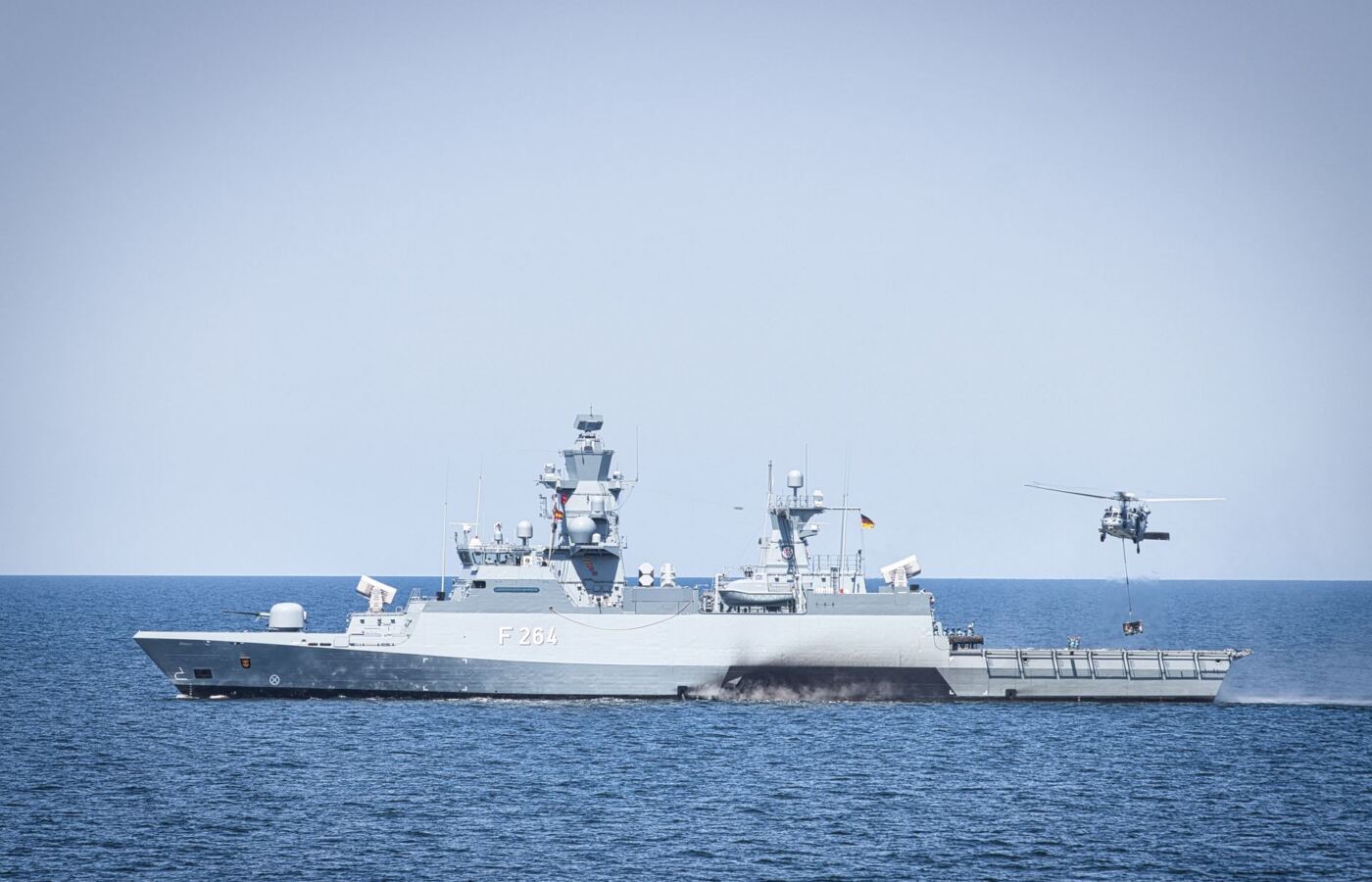
The F128, as presented by the German Federal Armed Forces, has a length of 121 meters and a displacement of approximately 4,000 tons. Its basic crew complement is 121 soldiers. Rather than being simply a scaled-down version of the F126, it is closer to a separate design that combines anti-submarine, anti-aircraft, and anti-ship capabilities in a relatively small hull.
The primary mission is the detection and attack of submarines. The bow-mounted sonar and towed sonar will be used to locate underwater targets, and the MU90 lightweight torpedo is planned to be used as the attack weapon. The Sea Tiger ship-borne helicopter will also be deployed.
The F128 will be equipped with a vertical launch system for air defense missiles, missile launchers for surface and land targets, as well as naval guns and sensors. Therefore, the F128 is not a ship that focuses solely on anti-submarine warfare, but rather a multi-mission vessel.
Anti-submarine warfare capabilities are also linked to the safety of underwater communication networks, energy facilities, and commercial shipping routes. The military capability to monitor submarines in the North Atlantic and North European waters is not solely a problem for the German Navy. It is related to the military capability to protect underwater infrastructure and maritime traffic.
It crammed a multitude of tasks into a small hull.
Instead of gaining speed, its scalability was reduced.
The German Federal Armed Forces stated that the MEKO A-200 DEU is based on a design that has been exported and constructed in several countries. They assessed that it poses a lower risk of project execution compared to the completely newly designed F126. Utilizing existing designs and production and supply chains is also advantageous for the delivery schedule, which is planned for the end of 2029.
TKMS CEO Oliver Burkhardt also stated, “Timeline delivery is a key factor for us here.” Regarding the contract for an additional four vessels, he said, “With the order for the four option vessels, we can secure ongoing series production for the long term.”
The German Navy aims to reduce its anti-submarine warfare capability gap, while TKMS secures a domestic naval surface ship project involving 8 vessels. The decision to utilize existing designs addresses the needs of both parties simultaneously.
However, speed does not solve all problems. There is still a possibility of technical delays in the process of integrating sensors and weapons systems for the German market. The German Federal Armed Forces also stated that there may be limited opportunities to add new weapons and sensors, and that the living space for the crew may become more cramped.
In exchange for adopting it quickly, they have essentially sacrificed some future flexibility.
It is necessary to distinguish between estimated values obtained from equipment and models.
In the combat systems and sensor fields, the participation of Saab has been confirmed. Saab announced that it will supply and integrate the 9LV combat system, the Sea Giraffe 4A fixed-face long-range surveillance radar, the Sea Giraffe 1X lightweight multi-purpose surveillance radar, and passive sensors for the four new MEKO A-200 DEU vessels. The supply also includes the composite upper structure.
Saab’s initial equipment and integration contract for the first four vessels is valued at SEK 8.7 billion. British company MSI Defence Systems has signed a contract to supply 12 DS30M 30mm naval gun systems for the initial four vessels, with a contract value of £29.7 million.
Saab CEO Mikael Johansson stated that these systems will significantly enhance the German Navy’s anti-air, anti-submarine, and anti-surface warfare capabilities.
However, not all of the deployments shown in the exhibition models can be considered as the final equipment. Certain details mentioned in some sources, such as the 16-cell Mk 41 VLS, the 21-cell RAM launcher, the NSM launcher, the unmanned aerial vehicle operation capability, and the ability to accommodate a helicopter of the 11-tonne class, have not been confirmed in official German government documents.
It needs further confirmation whether the Saab combat system and the MSI DS30M system are applied identically to the additional 4 ships. The final total project cost for all 8 ships, as well as the price per ship, have not yet been officially confirmed. The contract terms are more important than the model.
The actual test platforms will be delivered in 2029.
The confirmed facts are clear. The German Navy will procure 8 MEKO A-200 DEU vessels. The first 2 are under construction, and the delivery of the lead ship is scheduled for the end of 2029.
The F128 is not a ship that directly replaces the F126, maintaining the same scale and role. It is a choice to compensate for the anti-submarine warfare gap that arose after the F126 project ended, using a relatively smaller ship. Germany aims for rapid deployment by utilizing existing designs.
However, the schedule is still in the planning stage. While the existing design can reduce business risks, the challenge of integrating sensors and weapons systems for use in Germany remains. The actual delivery date and the final equipment configuration will be verified during the construction process.
There are three key points to be verified: First, whether the first two ships under construction are progressing according to plan. Second, how the anti-submarine warfare capability and the air defense and anti-ship armament systems are integrated. Third, when the total project cost for all eight ships will be clearly defined.
The F128 is a realistic modification proposed after the F126 project was halted. However, even a realistic option becomes another delayed promise if it fails to meet the deadlines and cost requirements.
The true test for the F128 is not at the exhibition hall, but at the dock at the end of 2029.
Frequently Asked Questions.
Questions
Is the F128 a model for exhibition purposes, or is it an actual vessel of the German Navy?
This is a real procurement project. The German Navy will acquire eight MEKO A-200 frigates. The first two are already under construction, and the delivery of the lead ship is scheduled for the end of 2029.
Questions
How many F128 ships will be built?
The total project scope involves 8 vessels. Initially, 4 vessels were considered, but after the F126 project concluded on June 24, 2026, the required quantity increased to 8. TKMS announced that it signed a contract on November 17, 2026, for an additional 4 vessels.
Questions
Is the F128 a smaller or less powerful vessel than the F126?
The F128 is not a vessel designed to replace the F126 with the same size and role. It is 121 meters long, has a displacement of approximately 4,000 tons, and is designed to focus on anti-submarine warfare while also performing air defense and anti-ship functions.
Questions
What is the primary mission of the F128?
Its core mission is submarine detection and attack. It will include a bow-mounted sonar, a towed sonar, the MU90 lightweight torpedo, and the Sea Tiger ship-borne helicopter. It is also planned to be equipped with a vertical launch system for air defense missiles, and missile launchers for surface and land targets.
Questions
Has the total price for the eight F128 frigates been finalized?
Based solely on the information currently available, the final total project cost and the per-unit price for all 8 vessels have not been officially confirmed. The initial equipment and integration contract with Saab for the first 4 vessels is valued at SEK 8.7 billion, while the initial contract with MSI Defence Systems for the DS30M systems for the first 4 vessels is valued at £29.7 million.
Questions
Is the weapon configuration shown in the exhibition model the final, confirmed configuration?
It cannot be definitively stated. Some of the weapons and sensor configurations shown in the model may vary depending on the final contract and integration results. Certain details were not confirmed even in official German government documents.