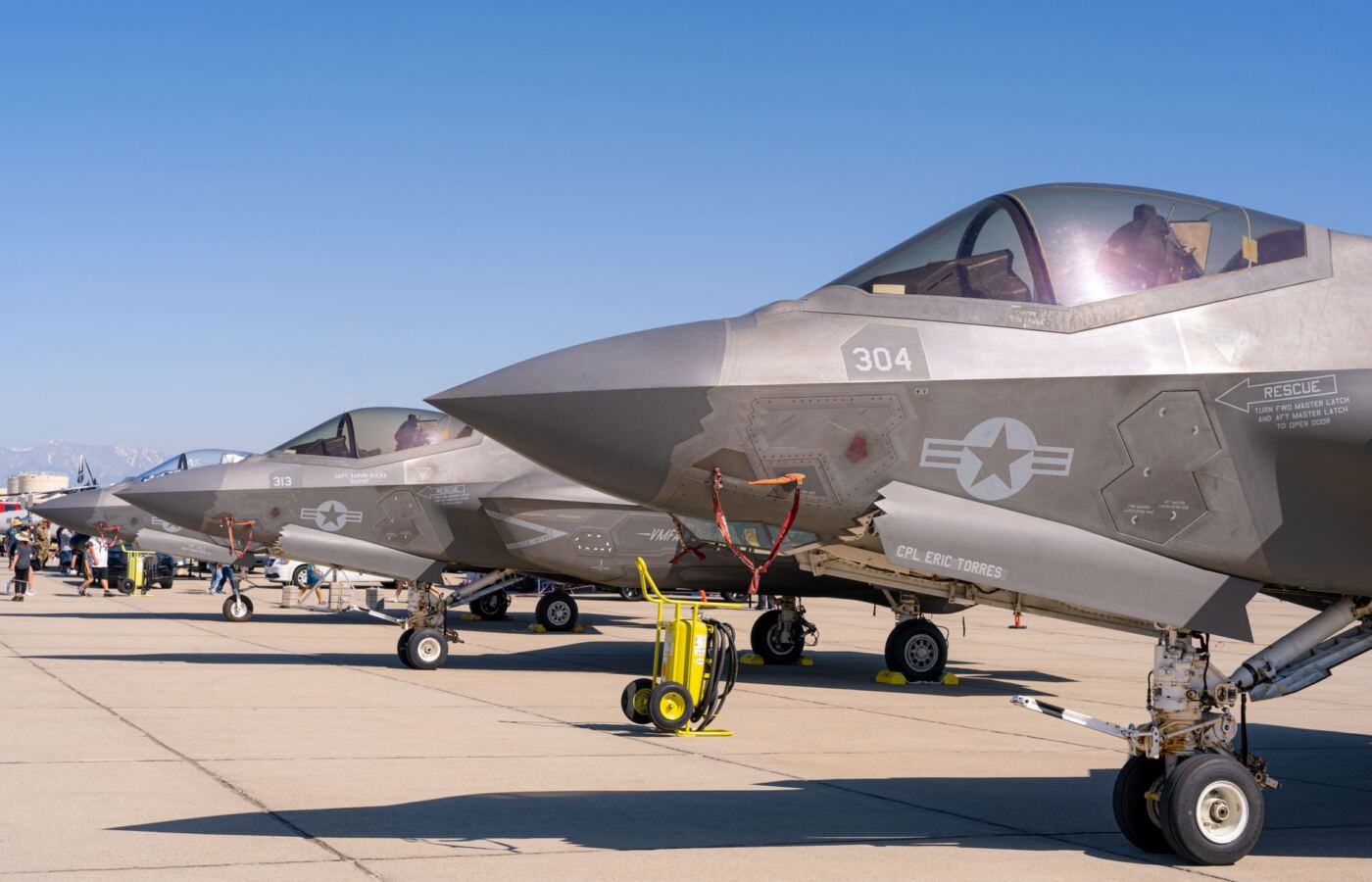
The F-35 is neither the fastest fighter nor the most agile in every kind of air combat. So why do Western countries keep choosing it?
In 2025, 191 aircraft were delivered. That surpassed the previous annual record of 142, and by 2026 the global F-35 fleet is approaching 1,300 aircraft.
There is one question that gets to the heart of the F-35.
The F-35 is chosen not because it tops every performance chart, but because it can serve as the standard that links the Western defense network together.
- The F-35 is not one aircraft but three ways of building a fighter
- Why did one fighter become a common foundation for several countries?
- What made it a standard was not speed, but the ability to see first and move together
- The price is high sustainment costs and low availability
- Which countries are best suited to the F-35?
- Frequently asked questions
The F-35 is less a single fighter than a family of three variants. The Air Force, Marine Corps and Navy use them in different places and in different ways.
The F-35A is the conventional takeoff and landing variant. It operates from standard runways and was designed to succeed the F-16 and A-10 in the U.S. Air Force.
The F-35B takes off over a short distance and lands vertically. That allows it to operate from short runways and amphibious assault ships, where it serves as a successor to the U.S. Marine Corps’ AV-8B and F/A-18.
The F-35C is the carrier variant. Its larger wings and arresting hook enable it to take off from and land on aircraft carriers.
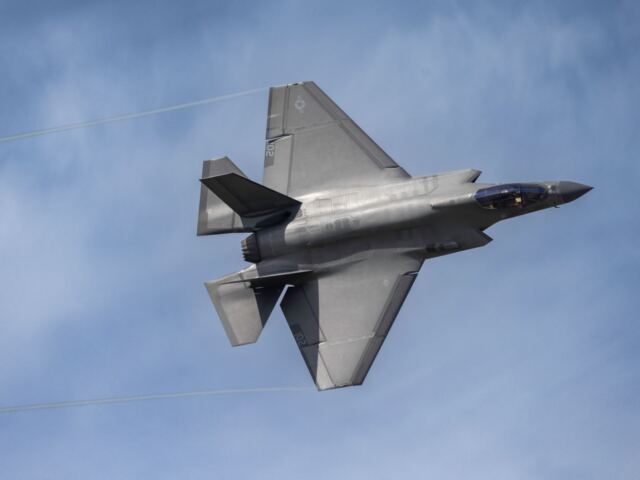
The F-35A, the best-known variant, has a single engine and a single-seat cockpit. It has a top speed of Mach 1.6, a range of more than 1,350 miles on internal fuel, and a payload capacity in the 18,000-pound class.
The three aircraft differ in appearance and operation, but what matters is that they belong to the same family. That reduces the burden of developing entirely different fighters for different military services.
The system matters more than the shape.
The F-35 is not one aircraft but three ways of building a fighter
Interest in the F-35 goes well beyond a single performance chart. The aircraft has become a common platform that is changing how multiple countries conduct operations, maintain aircraft, employ weapons and share intelligence.
Lockheed Martin said it delivered 191 F-35s in 2025. That was 49 more than the previous annual record of 142.
According to official F-35 program materials, 20 countries had either acquired or planned to acquire the aircraft as of 2026. The global fleet had also surpassed 1,150 aircraft in service.
At that scale, the F-35 stops being a single nation’s procurement program and becomes a shared ecosystem. The more countries operate the same family of aircraft, the stronger the case for linking their training and intelligence-sharing networks.
That is why a 2026 Government Accountability Office report described the F-35 as a major joint program shaping the long-term force structure of the United States and its allies. It also explains why costs and availability have become debates just as important as performance.
The more widely it is used, the more it becomes a standard.
Why did one fighter become a common foundation for several countries?
The F-35 became a standard not because it is the fastest or most maneuverable fighter. Its real advantage is that the alliance as a whole can use a common system to see first, share information and strike in contested areas.
The F-35’s stealth design is not the product of a single technology. Its radar-reducing shape, radar-absorbing materials, internal weapons and fuel carriage, and measures to reduce the engine’s heat signature all work together.
Stealth is like hiding in a dark room. It does not make an aircraft disappear completely; it makes it harder for an opponent to detect and track.
It is not a vanishing act.
The aircraft carries a range of sensors, including radar, infrared sensors, electro-optical systems and electronic-warfare equipment. Together, they gather information about the surrounding battlespace.
The crucial point is that this information is not presented separately. The F-35 is designed to fuse sensor data and deliver it to the pilot while also sharing tactical information with air, ground and naval forces.
The F-35 is therefore less a fighter that solves every problem on its own than a sensor, command and strike node that collects and distributes information across the battlespace. It is like a scout with exceptionally sharp eyes using a radio to keep multiple units informed.
The F-35’s core strength is not its weapons but its connectivity.
The F-35A can reach Mach 1.6, withstand 9G maneuvers and carry a payload in the 18,000-pound class. Its internal weapons carriage preserves stealth, while external weapons can be added when necessary.
That configuration changes its advantages according to the mission. Early on, the aircraft can operate while remaining difficult to detect; once the threat has diminished, it can carry more weapons externally.
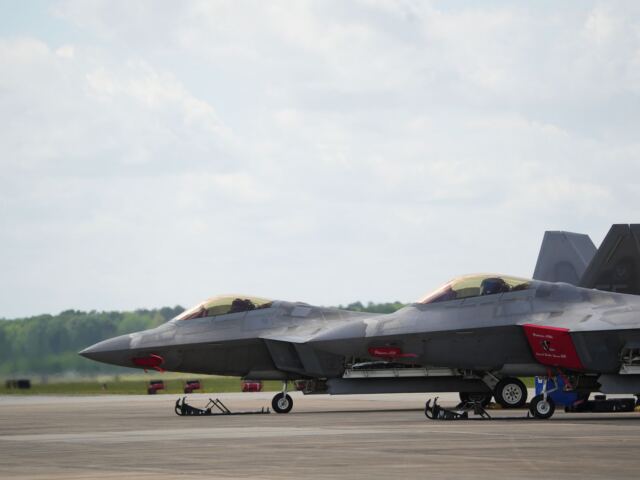
The F-22 complements the F-35 as an aircraft specialized for air superiority. The F-15EX, with its large weapons payload and long service life, is planned as a force that supports the F-35 and F-22.
In other words, the F-35’s strength does not lie in setting every record by itself. It lies in producing a greater effect when connected to other fighters.
It is stronger as part of a team.
What made it a standard was not speed, but the ability to see first and move together
The F-35’s advantages do not come free. Maintaining its stealth shaping, complex sensor suite and multinational support structure brings substantial costs and maintenance challenges.
According to the U.S. Government Accountability Office, the mission-capable rate for the entire F-35 fleet fell from 67 percent to 44 percent between fiscal years 2021 and 2025. The fully mission-capable rate, meaning aircraft ready to perform every assigned mission, declined from 38 percent to 25 percent.
Availability does not simply mean whether an aircraft is sitting in a hangar. The standard is whether it is ready for an actual mission, so a low figure means that a country cannot immediately use as many aircraft as it owns.
Aircraft owned and aircraft ready to deploy are not the same thing.
Sustainment costs are also rising. A 2026 GAO report said the estimated cost of sustaining the F-35 in 2025 had increased by $18.8 billion from the previous year.
It also estimated that roughly $13.7 billion in additional funding would be needed to restructure the global support system during fiscal years 2026 through 2031. Buying the aircraft is not where the costs end.
Stealth itself should not be misunderstood. The F-35 is not invisible, and carrying large numbers of weapons externally changes both its radar cross-section and its mission profile.
Nor is the F-35 the best aircraft for every mission. It cannot replace the F-22, optimized for air superiority, or the F-15EX, designed to prioritize maximum weapons capacity, in every situation.
Performance comes with an operational burden.
The central point is clear: the F-35 is an aircraft that prioritizes the efficiency of a connected force over any single record set by the fighter itself.
The price is high sustainment costs and low availability
Countries that need to penetrate dense air-defense networks, detect threats first and strike quickly have a strong reason to consider the F-35. Its advantages also grow in environments where multiple forces must exchange information in real time.
The right variant depends on where it will operate.
- If carrier operations are central, choose the F-35C
- If short runways or amphibious assault ships are required, choose the F-35B
- If the aircraft will use long runways and large air bases, choose the F-35A
The mission and the base come first.
By contrast, countries that place the greatest emphasis on peacetime sortie rates and long-term sustainment costs should not rush into a contract. They need to examine the parts supply chain, maintenance infrastructure, software upgrade costs and target availability rates first.
When carrying large weapons loads matters more, complementary forces such as the F-15EX, upgraded F-16s and the F/A-18 family should also be considered. That does not make them cheap substitutes; they simply perform different roles from the F-35.
Ultimately, choosing the F-35 as a primary standard cannot be decided by top speed alone. The real questions are whether a country intends to share information with allied forces in high-threat environments and whether it can absorb the aircraft’s sustainment costs and low availability rates.
The F-35 is not an all-purpose aircraft that replaces every fighter. Its greatest value comes when it is operated as a core node in the Western defense network.
It is a powerful choice for countries that need a common standard.
For countries that prioritize simple operations and high sortie rates, however, the F-35 alone is unlikely to be the answer. They must choose among the F-35A, F-35B and F-35C based on their bases and ships, then calculate costs and availability alongside complementary forces such as the F-22, F-15EX, upgraded F-16s and the F/A-18 family.
Which countries are best suited to the F-35?
Q. Is the F-35 the fastest fighter?
A. No.
The F-35A’s official top speed is Mach 1.6. Its defining strengths are stealth, sensor fusion and information-sharing—not maximum speed.
Q. Is the F-35 completely invisible to radar?
A. No.
Stealth makes an aircraft harder to detect and track; it does not make it completely transparent. Carrying large numbers of external weapons also changes its radar cross-section and mission profile.
Q. Which is the best of the F-35A, F-35B and F-35C?
A. It depends on the operating environment.
The F-35A is suited to conventional runways, the F-35B to short runways or amphibious assault ships, and the F-35C to aircraft carriers.
Frequently asked questions