K30 Biho Self-Propelled Anti-Aircraft Gun: Comparative Analysis
Overview
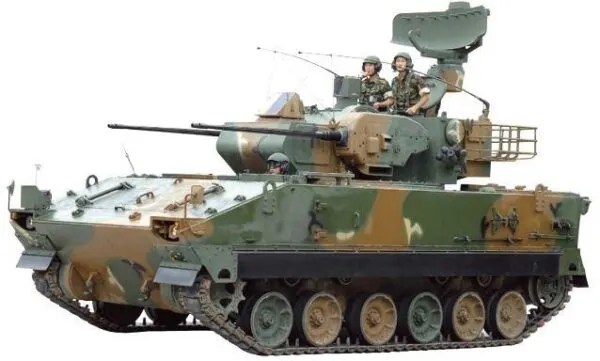
The K30 Biho is a self-propelled anti-aircraft gun system independently developed by South Korea, designed to effectively defend against low-altitude air threats including fixed-wing aircraft, helicopters, and unmanned drones. The system combines rapid response capabilities with excellent mobility and can be upgraded to the Shin-Gung hybrid variant, which adds Shin-Gung surface-to-air missiles when required.
- Key Characteristics
- Powerful anti-aircraft firepower: Twin 30mm autocannons
- Rapid response: Automatic target tracking and real-time engagement capability
- Mobility and survivability: Based on the K200 armored personnel carrier platform with exceptional cross-country performance
- Network integration: Compatible with integrated air defense systems for coordinated operations
Development Background
The South Korean Army had relied on the aging M167 Vulcan self-propelled anti-aircraft gun, which suffered from significant limitations in mobility, firepower, and detection capabilities. As airborne threats from North Korea and neighboring nations increased, the need for a more effective low-altitude air defense system became pressing. The K30 Biho was developed to address these operational requirements.
- Development Timeline
- Late 1980s: Indigenous self-propelled anti-aircraft gun development initiated
- 1996: K30 Biho prototype unveiled
- 1999: Mass production begins and operational deployment
- 2010s onwards: Biho hybrid variant with integrated Shin-Gung missiles introduced
Strengths and Weaknesses
🔹 Strengths
✔ Rapid engagement response: Automatic target tracking with immediate fire capability ✔ Substantial firepower: Dual 30mm cannons capable of firing 1,200 rounds per minute ✔ Operational mobility: K200 platform foundation ensures high cross-country mobility ✔ Network-centric operations: Integration with air defense networks strengthens overall air defense coverage
🔻 Weaknesses
❌ Cannon-only limitation: Without missile integration, engagement range is restricted ❌ Supersonic threat challenge: Optimized for low-speed, low-altitude targets ❌ Limited armor protection: Base armor level leaves the system vulnerable to anti-tank threats
Regional Comparison: Self-Propelled Anti-Aircraft Guns (China, Japan, North Korea)
| Specification | K30 Biho (South Korea) | PGZ-09 (China) | Type 87 SPAAG (Japan) | North Korean SPAAG |
|---|---|---|---|---|
| Weight | 26 tons | 35 tons | 45 tons | 25–30 tons (estimated) |
| Dimensions (Width × Length × Height) | 3.0m × 6.8m × 3.2m | 3.2m × 7.5m × 3.5m | 3.5m × 7.8m × 3.6m | 3.0m × 7.0m × 3.3m (estimated) |
| Maximum Speed | 65 km/h | 55 km/h | 60 km/h | 50 km/h (estimated) |
| Armament | Twin 30mm cannons | Twin 35mm cannons | Twin 35mm cannons | 30–37mm cannons (estimated) |
| Armor | Standard ballistic protection | Enhanced armor | Composite armor | Standard ballistic protection (estimated) |
| Engine Output | 450 horsepower | 500 horsepower | 600 horsepower | 400–500 horsepower (estimated) |
| Competitive Advantage | Superior mobility, automatic target tracking | Exceptional firepower and mobility | Superior defensive capability | High production volume |
Advanced Comparison: Self-Propelled Anti-Aircraft Guns (United States, United Kingdom, Russia, France)
| Specification | M-SHORAD (United States) | Sky Sabre (United Kingdom) | Tunguska (Russia) | Mistral M3 (France) |
|---|---|---|---|---|
| Weight | 22 tons | 30 tons | 34 tons | 20 tons |
| Dimensions (Width × Length × Height) | 2.8m × 7.0m × 3.0m | 3.2m × 7.5m × 3.4m | 3.4m × 7.8m × 3.6m | 2.9m × 6.5m × 3.0m |
| Maximum Speed | 80 km/h | 70 km/h | 60 km/h | 75 km/h |
| Armament | 30mm cannon + Stinger missiles | 35mm cannon + missiles | 30mm cannon + 9M311 missiles | Mistral short-range missiles |
| Armor | Armored vehicle base platform | Composite armor | Composite armor + ERA | Standard ballistic protection |
| Engine Output | 350 horsepower | 500 horsepower | 780 horsepower | 300 horsepower |
| Competitive Advantage | U.S. military network integration | Superior armor protection | Powerful firepower with integrated missiles | Compact, lightweight design with rapid response |
Future Development Direction
- K30 Biho PIP upgrade: Modernization of sensor and fire control systems underway
- Enhanced protection: Evaluation of advanced armor and active defense systems
- Networked warfare capability improvement: Strengthening real-time data linking
- International export expansion: Market penetration in Southeast Asia and Middle East