Overview
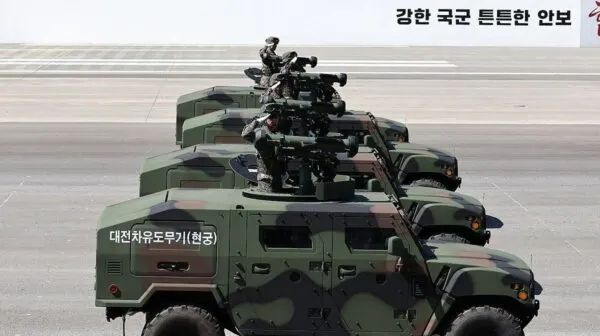
The Hyungung is a state-of-the-art portable anti-tank missile independently developed by South Korea, designed to engage tanks and heavily armored vehicles with precise, powerful strike capabilities. Utilizing fire-and-forget technology and top-attack methodology, it effectively counters the diverse threats inherent in modern warfare.
- Key Features
- Fire-and-Forget Capability: Enhanced survivability for gunners
- Top-Attack Mode: Targets the vulnerable upper surfaces of armored vehicles
- Precision Guidance: Infrared imaging guidance (IIR) system ensuring high accuracy
- Exceptional Portability: Deployable by infantry and vehicle-mounted configurations
Development Background
South Korea’s military assessed existing anti-tank weapons as having significant limitations in performance, accuracy, and portability. As North Korean forces modernized their tank and armored vehicle capabilities, the ROK Army recognized the urgent need for a more effective countermeasure, spurring the development of an advanced portable anti-tank missile system.
- Development Timeline
- 2007: Hyungung development program initiated
- 2015: Performance evaluation and prototype missile unveiled
- 2017: Initial fielding with South Korean Army
- 2020 onward: Export promotion and ongoing performance upgrades
Strengths and Weaknesses
🔹 Strengths
✔ Precision Strike Capability: Infrared imaging guidance maximizes hit probability ✔ Outstanding Portability: Individual infantry operation with multiple platform integration options ✔ Fire-and-Forget Function: Significantly increases operator safety and survivability ✔ Top-Attack Configuration: Accurately exploits vulnerabilities in modern main battle tanks
🔻 Weaknesses
❌ Cost Considerations: Advanced guidance systems drive up unit costs ❌ Range Limitations: Maximum effective range of approximately 2.5 kilometers ❌ Environmental Constraints: Weather and visibility conditions may affect accuracy
Regional Comparison: Anti-Tank Missiles (China, Japan, North Korea)
| Specification | Hyungung (South Korea) | HJ-12 (China) | Type 01 LMAT (Japan) | Bulsae-3 (North Korea) |
|---|---|---|---|---|
| Weight | 24 kg | 22 kg | 17.5 kg | ~20 kg (estimated) |
| Dimensions (Width × Length × Height) | 150mm × 1.2m × 250mm | 140mm × 1.25m × 240mm | 140mm × 0.97m × 250mm | 130mm × 1.1m × 230mm (estimated) |
| Maximum Velocity | 720 km/h | 720 km/h | 700 km/h | 650 km/h (estimated) |
| Warhead Type | Tandem HEAT | Tandem HEAT | Tandem HEAT | Single HEAT |
| Armor Penetration | 900mm+ | 1,100mm+ | 700mm+ | 600mm (estimated) |
| Range | 2.5 km | 4 km | 2 km | 2 km (estimated) |
| Guidance System | Infrared Imaging (IIR) | Infrared Imaging (IIR) | Laser | Wire-guided |
| Key Advantages | Superior accuracy, top-attack capability | Extended range, high penetration power | Lightweight, excellent portability | Simplified construction, high-volume deployment feasibility |
Developed Nations Comparison: Anti-Tank Missiles (USA, UK, Russia, France)
| Specification | Hyungung (South Korea) | Javelin (USA) | NLAW (UK) | Kornet-EM (Russia) | MMP (France) |
|---|---|---|---|---|---|
| Weight | 24 kg | 22.3 kg | 12.5 kg | 33 kg | 15 kg |
| Dimensions (Width × Length × Height) | 150mm × 1.2m × 250mm | 127mm × 1.1m × 280mm | 115mm × 1.02m × 240mm | 152mm × 1.2m × 270mm | 140mm × 1.3m × 250mm |
| Maximum Velocity | 720 km/h | 750 km/h | 800 km/h | 1,000 km/h | 720 km/h |
| Warhead Type | Tandem HEAT | Tandem HEAT | Single HEAT | Tandem HEAT | Multi-purpose |
| Armor Penetration | 900mm+ | 750mm+ | 500mm+ | 1,300mm+ | 1,000mm+ |
| Range | 2.5 km | 2.5 km | 1 km | 8 km | 4 km |
| Guidance System | Infrared Imaging (IIR) | Infrared Imaging (IIR) | Predictive | Laser Beam | Fiber Optic |
| Key Advantages | High accuracy, top-attack mode | Combat-proven performance, U.S. military standard | Superior portability, simple operation | Long-range capability, exceptional penetration power | Multi-mission capability, precision engagement |
Future Development Direction
- Extended Range: Development of medium to long-range variants in the 3-4 kilometer class
- Warhead Improvements: Enhanced penetration capability and multi-purpose warhead development
- Platform Expansion: Integration with vehicle-mounted and unmanned systems
- Export Growth: Promotion of sales to Southeast Asian and Middle Eastern nations
K2 Black Panther Main Battle Tank: A Comprehensive Analysis
Analysis of the K21 Infantry Fighting Vehicle
Chunmoo Multiple Launch Rocket System (MLRS): A Comparative Analysis