Domestically developed close-in weapon system CIWS-II, finally completed with Korean technology
A next-generation close-in weapon system (CIWS-II) is being developed for installation on the Republic of Korea Navy’s ships, and it is being developed through complete domestic production.
The Korean Navy initially preferred the Dutch Goalkeeper system for its destroyers. However, the company that manufactured the Goalkeeper system, having received a relatively small order, was unable to generate sufficient profit and, when expressing its willingness to be acquired by a Korean company, proposed an excessively high price.
Ultimately, the goalkeeper system failed due to poor sales, but the maintenance license was granted to LIG Nex1. Subsequently, in the construction of new warships, the close-in defense system was exclusively procured from the American company, Raytheon.
With the disappearance of its competitor, Goalkeeper, Pellan has raised its prices by more than double. This is an example of unfair business practices. The Republic of Korea Navy, dissatisfied with this behavior, decided to develop a CIWS system independently, and the resulting product is now on the verge of being deployed on our escort ships and destroyers.
It is likely to be installed starting with the Chungbuk-class frigate. The most significant feature of this CIWS-II is that all of its components, including the turret, radar, electro-optical equipment, and fire control system, are composed of our own technology.
This weapon is considered the “ultimate defense” for intercepting threats approaching from the air, such as hypersonic anti-ship missiles, small drones, and unmanned surface vessels. It serves as the last line of defense.
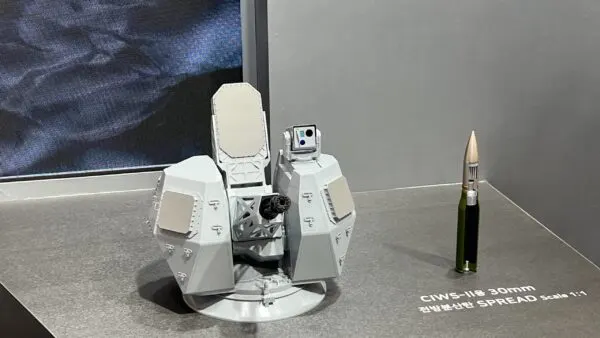
🔍 CIWS-II: Korean-type features
The previously deployed U.S.-made Phalanx CIWS used a 20mm caliber gun. However, our CIWS-2 uses a 30mm gun, the same as the powerful Golkiper system.
- Turret: Supplied by Hanwha Aerospace, equipped with an automated 30mm multi-barrel gun system.
- Radar: LIG Nex1 has domestically developed an AESA multi-function tracking radar.
- EO/IR Sensor: Hanwha Systems develops electro-optical tracking equipment.
- Fire control system: Developed by the Agency for Defense Development (ADD) for system integration and control system design.
With this, a complete, domestically produced weapon system will be created, encompassing the entire process from missile detection to interception, all using Korean technology.
🧭 International Geopolitics and Technological Implications
Currently, the most threatening factors in naval warfare are hypersonic missiles, drone swarms, and stealthy attack platforms that are difficult for radar to detect. Accordingly, defensive systems must also be capable of detecting and immediately intercepting them. CIWS-II will combine AESA radar-based automatic detection and tracking with the accurate striking capability of a high-speed rapid-fire cannon. It is also a highly symbolic example in that South Korea’s indigenous weapons-development capabilities could lead to breaking into export markets and strengthening military sovereignty in the future.
💡 Implications and Outlook
- Technological Independence : The development of high-performance defense weapons using domestic technology, which previously relied entirely on imports, marks a significant milestone in South Korea’s defense industry history.
- Increased operational flexibility: It can quickly perform repairs, modifications, and tactical adjustments based on its own judgment.
- Increased export potential: There is a possibility that demand for the CIWS-II may arise in the navies of medium-sized countries in Southeast Asia, the Middle East, and other regions.
- Integration with next-generation weapon systems: In the future, we can expect synergy with the entire defense system, including the Korean-type destroyer (KDDX), and light aircraft carriers.
I am eagerly anticipating the day when we can see the CIWS-2, which is manufactured using our own technology. It is said that the new CIWS-2, with its spread-shot ammunition, can effectively defend a wider area, and I am very much looking forward to seeing it. I would like to express my sincere gratitude to all the engineers and researchers who have worked hard on the development of this technology.
Comparative Analysis of Submarine-Launched Ballistic Missiles (SLBMs).