U.S. Marine Corps MV-22B Acquisition: Completion with the 359th Aircraft
The U.S. Marine Corps received the 359th and final planned MV-22B Osprey aircraft on July 28, 2026. According to a statement from the U.S. Marine Corps, this delivery completes the procurement of the planned MV-22B quantity, and the focus of the program is shifting from the introduction of new aircraft to long-term operation and modernization.
This milestone marks the completion of the MV-22B procurement for the U.S. Marine Corps. It does not signify the end of operations for the entire V-22 family of aircraft, which includes other variants such as the CMV-22B for the U.S. Navy and the CV-22B for the U.S. Air Force.
Since its operational deployment in 2007, it has logged over 680,000 flight hours
According to data from the U.S. Naval Air Systems Command, the MV-22B was developed as a medium-sized assault support aircraft to replace the CH-46E Sea Knight. It achieved initial operational capability in June 2007. In October of the same year, it was first deployed for combat operations in Iraq, marking the beginning of its full operational use.
The U.S. Marine Corps announced that, as of July 2026, the MV-22B fleet had flown more than 686,500 hours and conducted 114 operational deployments. Currently, the Osprey accounts for approximately 75% of the Marine Corps’ rotary-wing assault support missions and is used for troop transport, combat support, dispersed logistics, medical evacuation, and humanitarian aid.
Combining the capabilities of helicopters and fixed-wing transport aircraft
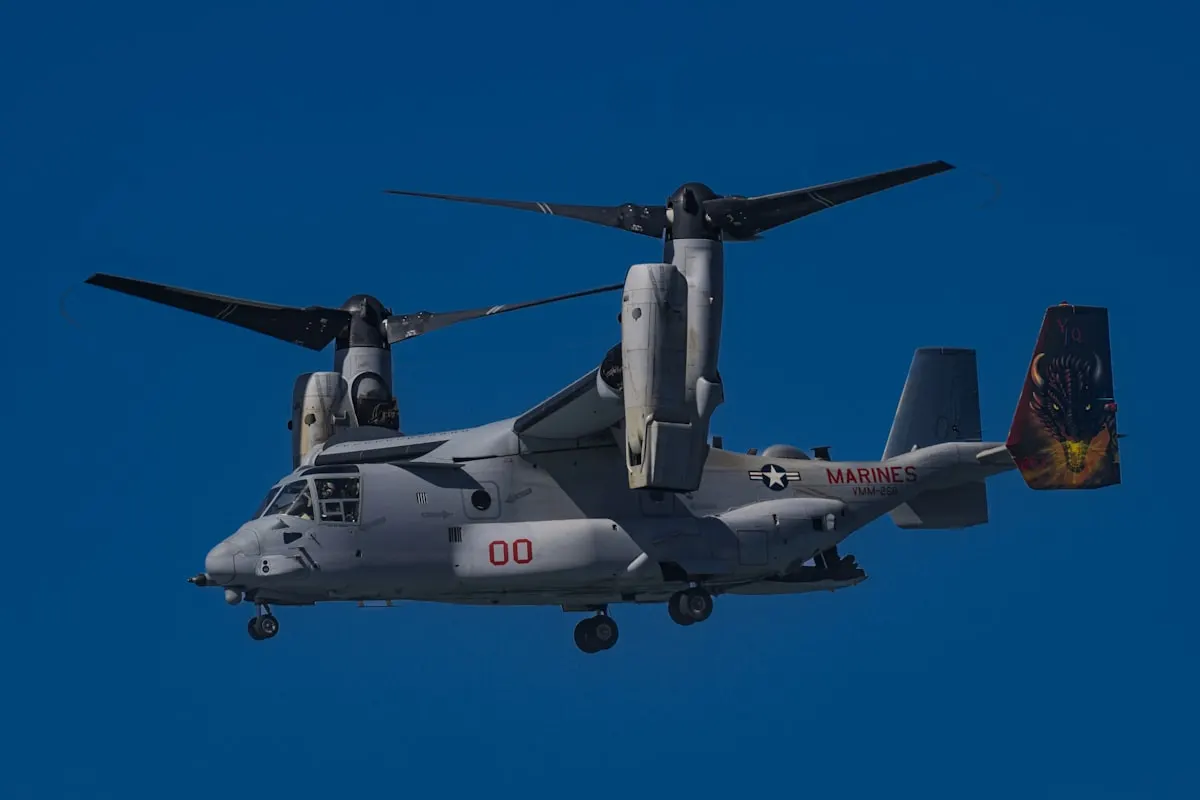
The MV-22B is a tiltrotor aircraft, meaning it has rotors and engines mounted on nacelles whose angles can be adjusted. It operates like a helicopter during takeoff and landing, and during cruising, the rotors rotate forward, allowing it to fly like a turboprop aircraft.
According to the aviation plan for the Marine Corps, the MV-22B can transport a maximum of 24 combat personnel. Its cruising speed is approximately 240 knots, and its maximum speed is approximately 280 knots. The combat radius, depending on the mission profile, is up to approximately 420 nautical miles, and its self-deploying range, based on aerial refueling, reaches approximately 2,100 nautical miles.
The aircraft’s main wing and rotor can be folded for storage on ships. Consequently, the MV-22B can launch from amphibious assault ships and rapidly transport troops and cargo to forward operating bases with limited runways and to austere landing zones.
Modernization efforts to operate until 2055
Following the acquisition of the final aircraft, the U.S. Marine Corps is pursuing a long-term modernization strategy to operate the MV-22B until 2055. This strategy focuses not only on extending the service life but also on reducing maintenance burdens, standardizing configurations across all aircraft, and enhancing safety and mission readiness.
The U.S. Marine Corps has announced several key improvements, including enhancements to the nacelle wiring, standardization of aircraft components, and redesign of critical parts. Furthermore, they plan to introduce an improved propeller gearbox that utilizes refined triple-melted steel components to enhance the reliability and operational longevity of the propulsion system.
The MV-22B, jointly developed by Boeing and Bell, has significantly expanded the operational range of the Marine Corps’ aviation forces. Even after new production ends, follow-on support programs, including parts supply, overhaul, software updates, and improvements to electronic warfare equipment, are expected to continue for decades.
The significance of the final acquisition
The delivery of the 359th MV-22B indicates the completion of a roughly 20-year process of fully integrating the Osprey aircraft into the Marine Corps. The key challenges moving forward are not increasing the number of aircraft, but rather maintaining the operational rate and safety of the existing fleet, as well as its ability to conduct long-range, dispersed operations.
As the U.S. Marine Corps develops forward operating base operations and distributed logistics concepts, the speed and vertical takeoff and landing capabilities of the MV-22B, which can connect naval and land forces, are expected to continue to play a crucial role.
Frequently Asked Questions (FAQ)
What is the serial number of the last MV-22B aircraft received by the U.S. Marine Corps?
This is the 359th aircraft, delivered on July 28, 2026. With this delivery, the U.S. Marine Corps has completed the acquisition of the MV-22B aircraft as planned.
When did the MV-22B Osprey begin operational service?
The U.S. Marine Corps declared the initial operational capability of the MV-22B in June 2007, and in October of the same year, it began its first combat deployment in Iraq.
What is the maximum number of personnel the MV-22B can carry?
In a typical troop transport configuration, the aircraft can carry up to 24 combat personnel. The actual number of personnel that can be carried varies depending on fuel load, cargo, flight distance, and the configuration of mission equipment.
Does the acquisition of the final aircraft signify the retirement of the Osprey?
No. The procurement of new MV-22B aircraft for the U.S. Marine Corps is complete. The existing aircraft will undergo modernization and maintenance and are scheduled to remain in service until 2055.
What are the differences between the MV-22B, CV-22B, and CMV-22B?
The MV-22B is a variant used by the U.S. Marine Corps for assault support, the CV-22B is used by the U.S. Air Force for special operations, and the CMV-22B is a variant used by the U.S. Navy for carrier-based logistics transport.