F-15EX Mission Transition: From Air Superiority Fighter to Multi-Role Combat Aircraft
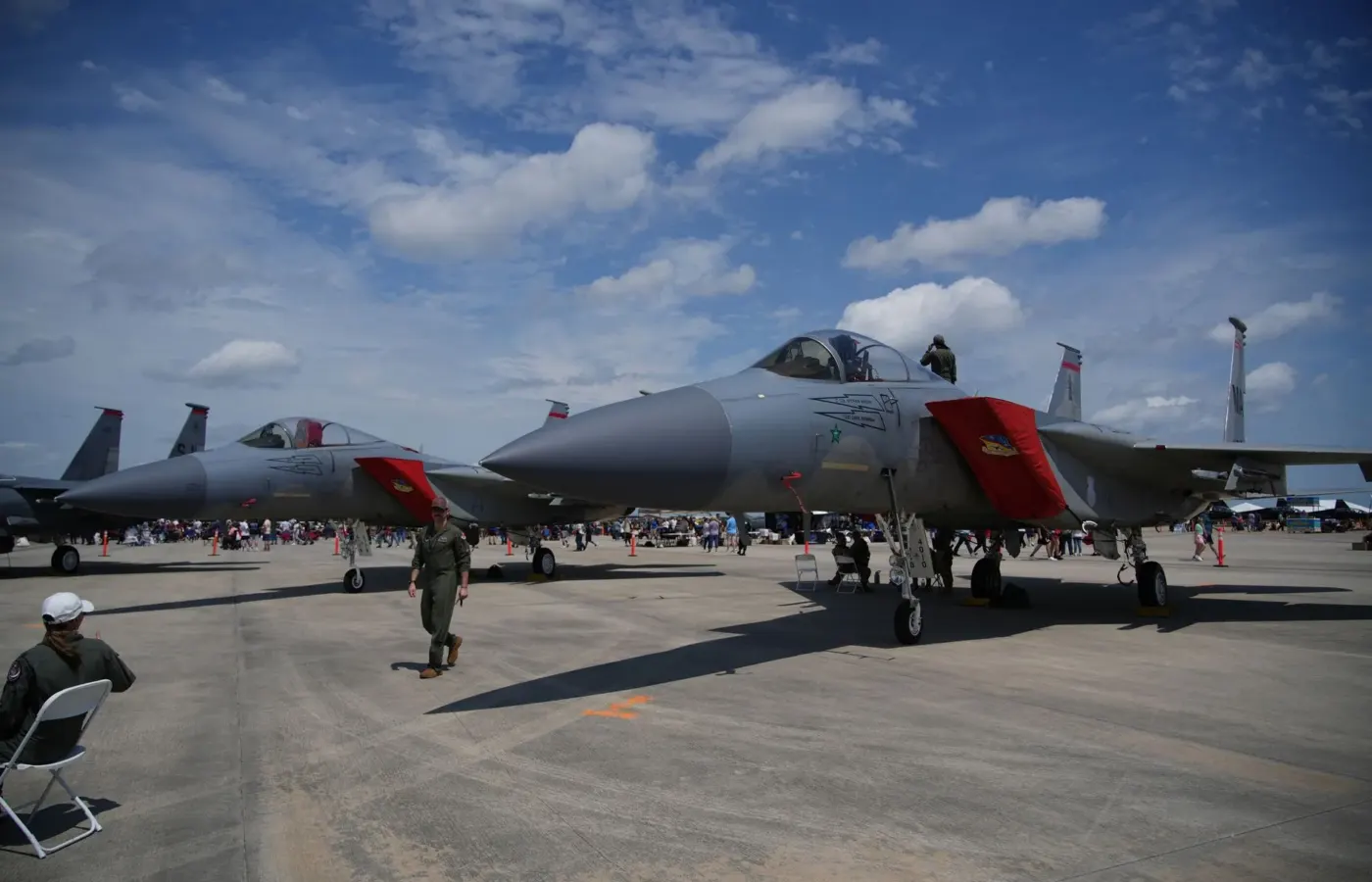
The F-15EX Eagle II, currently being adopted by the U.S. Air Force, is evolving into a multi-role fighter aircraft, expanding its capabilities from its original air superiority mission to include ground attack capabilities. Since the Oregon Air National Guard‘s 142nd Fighter Wing began operating the F-15EX in June 2024, it has replaced the F-15C, which was designed in the 1970s, and is becoming a fighter aircraft that meets the diverse requirements of modern warfare.
Fundamental Differences Between the F-15C and F-15EX
The F-15EX program involves the production of a completely new fighter aircraft, which is fundamentally different from the project of upgrading the F-15C currently used by the Air Force. The performance difference between the two fighter aircraft is significant.
The F-15C is a single-seat aircraft designed for air superiority missions, and it controls its control surfaces using a cable system. In contrast, the F-15EX Eagle II is a twin-seat aircraft capable of performing both air superiority and ground attack missions. The F-15EX is equipped with a modern fly-by-wire control system and a glass cockpit featuring large touchscreen displays.
Enhanced ground attack capability
The F-15EX is primarily used as a fighter aircraft to replace the F-15C/D and supplement the F-22. However, like the F-15E, it can also perform ground attack missions by equipping itself with a LANTIRN pod and a Sniper XR pod. This is because modern warfare blurs the lines between air combat and ground warfare.
The aircraft’s airframe has been substantially reinforced, the AN/APG-63 radar was replaced with the upgraded AN/APG-70, and ground precision-attack capabilities, including SAR (synthetic aperture radar) mapping and Patch mapping, were added. The F-15EX can carry 29,000 pounds or more of weaponry and can be equipped with up to 22 air-to-air missiles via AMBER racks, making it capable of carrying the most missiles in the U.S. Air Force.
Modern avionics and open architecture
The electronic equipment features an open-system architecture to facilitate potential future upgrades. This aligns with the design principles of the F-35, enabling the rapid integration of new software and weapon systems.
The F-15EX’s AN/APG-82(V)1 sensor has a detection range of 280 kilometers. The two General Electric F110-GE-129 engines provide 29,500 pounds of thrust each.
Operation plans and future prospects
The F-15EX is expected to replace the remaining F-15C/D aircraft in the U.S. Air Force and Air National Guard, performing homeland defense and air defense missions, and will support the F-22 and F-35 aircraft that operate on the front lines. The U.S. Air Force plans to deploy F-15C/D aircraft for homeland air defense missions until 2030, and then completely replace them with F-15EX aircraft.
The 2021 fiscal year defense budget allocated $1,230,000,000 for the procurement of 12 F-15EX aircraft, finalizing a total order of 20 aircraft and a planned total quantity of 144. As of May 2022, the U.S. Air Force reduced the order to 80 aircraft.
Frequently Asked Questions (FAQ)
Q. What is the biggest difference between the F-15EX and the F-15C?
The F-15EX is a newly designed fighter-bomber, featuring a fly-by-wire system, a glass cockpit, an enhanced airframe structure, and ground attack capabilities. In contrast, the F-15C is a pure air superiority fighter based on a design from the 1970s.
Q. When will the ground attack capability of the F-15EX be operational?
The F-15EX was designed from the outset to include ground attack capabilities, and the Oregon Air National Guard began operating it in June 2024. It can immediately perform this mission by equipping it with a ground attack pod.
Q. Why is the U.S. Air Force adopting the F-15EX instead of a next-generation fighter?
The F-22 has already ceased production, and its unit cost is high (ranging from $1.5 to $200 million per aircraft). The F-15EX can be developed rapidly based on existing technology, and its maintenance costs are relatively low, with a shorter pilot conversion period.
Q. What is the armament capability of the F-15EX?
The F-15EX can carry over 29,000 pounds of ordnance and is capable of carrying up to 22 air-to-air missiles. This is the largest missile payload capacity of any active-duty fighter aircraft in the U.S. Air Force.
Q. What is the radar performance of the F-15EX?
The aircraft is equipped with the AN/APG-82(V)1 AESA radar, which has a detection range of 280 kilometers. This provides the performance necessary for modern precision target tracking and ground attack missions.
Q. How many F-15EX aircraft is the U.S. Air Force planning to acquire?
The initial planned total quantity was 144 units, but the specific acquisition scale has been reduced since 2022. Currently, they are being deployed to the Oregon Air National Guard, and are scheduled to gradually replace the F-15C/D aircraft, which are responsible for homeland air defense, by 2030.