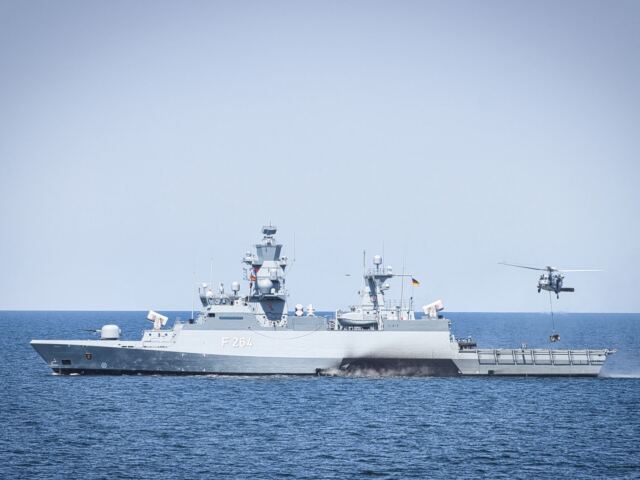
German Navy conducts test launch of Israeli LORA missile in the North Atlantic
The German Navy conducted a test launch of the IAI (Israel Aerospace Industries) LORA naval ballistic missile in the North Atlantic on the night of September 1, 2026. According to an IAI statement, the test was part of the German Navy’s operational experiment program, OPEX, and both launches successfully hit their targets along the pre-determined flight path.
This test demonstrates that the German Navy is evaluating long-range precision strike systems that can be operated from vessels. However, the success of the test does not automatically mean formal adoption or a purchase contract. The German Navy is likely to develop procurement plans based on the test results.
Operational vessels equipped with launch platforms and command systems
According to IAI, a German Navy operational vessel was used in the LORA tests, and a launch system and command and control equipment were installed on the vessel’s deck. In the two tests, the missiles flew towards the target and hit it with high precision, demonstrating that the weapon system and the missiles met the test objectives.
According to reports in the German media, the test was conducted in the North Atlantic, and safety measures were taken for ships and aircraft operating in the area prior to the launch. Specific details, such as the target and launch coordinates, have not been disclosed.
A maritime precision strike system with a maximum range of 430 km
According to the specifications released by IAI, the Naval LORA is a land-to-ground and ship-to-ground missile system with a range of 90 to 430 km. It uses a guidance system that combines satellite navigation and inertial navigation, and the manufacturer states that the circular error probable is approximately 10 meters across the entire range.
The LORA is a system that flies along a ballistic trajectory to attack targets at high speed, and is designed to target both fixed and mobile key facilities. A key feature of the naval model is its dedicated launch configuration and command and control equipment, which can be installed on vessels.
However, the performance figures provided by the manufacturer may vary depending on the operational environment, target information, electronic warfare conditions, and other factors. The actual operational deployment and operational concept are expected to be determined after additional testing and operational and technical evaluations by the German armed forces.
In conjunction with the German Navy’s “Marine 2035+” modernization program
The German Federal Armed Forces, in its “Marine 2035+” vision, which outlines the direction of the navy after 2035, emphasizes long-range maritime operational capabilities, high striking power, and the rapid experimentation of unmanned systems and new technologies, including those for the North Atlantic and the Baltic Sea.
According to the German Federal Armed Forces, OPEX is an experimental system designed to test new technologies and operational methods under conditions similar to real-world scenarios, in order to assess their feasibility and limitations. This LORA launch is considered not just a demonstration of an Israeli-made missile, but also a case where the German Navy has validated a new long-range strike capability within its own operational environment.
German Naval Inspector General Jan-Christian Kaack, a lieutenant general, described the successful test as an achievement that would go down in naval history. The German Navy will determine whether to adopt LORA as an actual weapon system, taking into account factors such as budget, operational requirements, vessel integration, and interoperability with allied systems.
A new test for German-Israeli defense cooperation
Germany and Israel have been expanding cooperation in the fields of air defense and missiles. Germany is introducing Israel’s Arrow 3 interceptor system, and the LORA test indicates the possibility that the scope of cooperation, which had been centered on defense systems, may expand to the area of sea-based precision strike capabilities.
If this test leads to a formal purchase, the German Navy will be able to add long-range land and sea target strike capabilities to its existing vessel fleet. At the same time, this provides the Israeli defense contractor with an opportunity to demonstrate the operational capabilities of the sea-based LORA to the navies of major European countries.
The key issue for the future is whether the test equipment can be converted into standard armament for the German Navy. Subsequent reviews are expected to include the integration of the launch system into vessels, the connection to command and control networks, ammunition supply and maintenance, and coordination with NATO operational plans.
Frequently Asked Questions (FAQ)
When did the German Navy conduct a test launch of the LORA missile?
The German Navy conducted a test launch of the LORA missile on the night of September 1, 2026, in the North Atlantic, and details of the event were released on September 2.
What model of missile was used in this test?
This is the Naval LORA, developed by Israel Aerospace Industries. It is operated by installing a launch platform and command and control equipment on a vessel.
What is the range of the LORA missile?
The Naval LORA unveiled by IAI has a range of 90 to 430 km. The manufacturer specifies a circular error probable of approximately 10 meters.
Has Germany already purchased the LORA system?
This test is at the operational experiment stage for the German Navy. While there is discussion of a procurement plan being developed following the successful completion of the test, there has been no official announcement confirming the signing of a formal purchase contract.
What is the significance of this test for the German Navy?
This demonstrates that the German Navy is exploring new capabilities that would allow it to precisely strike ground or maritime targets hundreds of kilometers away from its vessels. This is also related to the “Marine 2035+” modernization plan.
What is the impact of this test on defense cooperation between Germany and Israel?
This indicates the possibility of cooperation not only in air defense areas such as the Arrow 3 , but also in the area of sea-based precision strike. However, whether the actual expansion of cooperation will occur depends on subsequent evaluations and procurement procedures.