Three foreign frigates for reference by the U.S. Navy
The U.S. Navy’s frigate program initially began by using foreign warship designs, but its direction has now changed significantly. In December 2025, the U.S. Navy announced that it would develop a new small surface combatant, FF(X), based on the U.S. Coast Guard’s Legend-class National Security Cutter.
Therefore, it is difficult to regard Japanese, Korean, and Turkish frigates as official procurement candidates for the U.S. Navy at present. However, these vessels are representative overseas examples that can be used to compare the factors the U.S. Navy is likely to prioritize in its next frigates, including anti-submarine warfare, multipurpose operations, reduced crew requirements, and modularity.
Current status of the U.S. Navy frigate program
The U.S. Navy’s existing Constellation class was designed based on Italian Navy FREMM frigates, incorporating U.S. operational requirements and equipment. According to a U.S. Navy announcement, the ships were designed to perform anti-air warfare, anti-submarine warfare, anti-surface warfare, and electronic warfare missions, and were planned to be equipped with the Aegis Combat System, the Enterprise Air Surveillance Radar, and the Mk 41 Vertical Launching System.
However, the U.S. Government Accountability Office pointed out that the start of construction of the lead ship before the design was fully finalized increased the risk of schedule delays and cost overruns. Subsequently, the U.S. Navy reduced the planned construction of additional Constellation-class ships and shifted to a new program, FF(X), which was intended to be simpler and faster to produce.
Japan’s Mogami-class frigates
Strengths include low manpower requirements and multi-purpose design
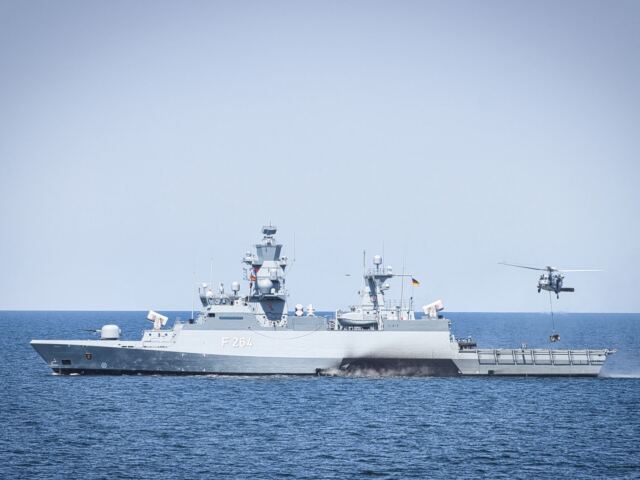
The Mogami-class vessels of the Japan Maritime Self-Defense Force are vessels that reduce the number of crew members compared to traditional large escort ships, and integrate anti-submarine warfare, anti-mine warfare, and patrol missions into a single platform. According to the specifications released by the Maritime Self-Defense Force, the standard displacement is approximately 3,900 tons, the length is 133 meters, the maximum speed is approximately 30 knots, and the crew consists of approximately 90 personnel.
The Mogami-class vessels operate a 5-inch gun, the SeaRAM close-in weapon system, anti-ship missiles, a variable depth sonar, a towed array sonar, unmanned underwater vehicles, and unmanned surface vessels. The combination of automation and unmanned systems is noteworthy, as it addresses both manpower shortages and the need to expand fleet size, which is something the U.S. Navy can learn from.
However, the basic model intended for the Japan Maritime Self-Defense Force was not developed with the premise of having the same level of air defense capability as the United States’ large surface combatants. If the United States were to adopt it, it would need to separately integrate the Aegis system, U.S.-made communication and electronic warfare equipment, and a vertical launch system.
Republic of Korea Ulsan-class Batch-III frigates
Multifunction radar and anti-submarine warfare capability
The Korean Ulsan-class Batch-III is a 3,600-ton vessel, larger than existing escort ships, and was developed to replace older-model escort ships and patrol vessels. According to a statement from the Defense Acquisition Program Administration, the lead ship, the Chungnam, is a next-generation escort ship with enhanced air defense and anti-submarine warfare capabilities.
The core features of this vessel are its active electronically scanned phased array radar and integrated combat system. The Agency for Defense Development stated that this combat system was developed to detect and track targets in all directions and to support engagements against multiple targets. Its ability to operate the Korean-made vertical launch system, its anti-submarine armament, and its capability to operate shipboard helicopters are also key features.
The Ulsan-class Batch-III design demonstrates relatively good suitability for anti-submarine warfare and network-centric operations, as required by the United States. However, if converted for use by the U.S. Navy, compatibility of the hull and combat systems, integration of U.S.-made weaponry, and additional design modifications to meet U.S. Navy survivability standards would be necessary.
Turkish I-class frigate
A platform aimed at localization and export expansion
Turkey’s I-class frigate is an expanded variant of the MILGEM national warship development program, designed to perform various missions, including patrol, maritime surveillance, exclusive economic zone patrol, and anti-surface warfare. Turkish defense company STM describes the I-class as a frigate designed with long-range operations and multipurpose missions in mind.
The defining feature of the I-class is that it expands the integration of Turkish-made combat systems, sensors, and weaponry while encompassing anti-ship, anti-air, and anti-submarine missions in a single platform. This approach aims to reduce reliance on specific foreign equipment and utilizes domestic industrial capabilities to continuously improve the vessel.
From the perspective of the U.S. Navy, the high proportion of domestically produced equipment and the flexibility of the vessel design could be advantages. However, because the construction of U.S. vessels requires production at domestic shipyards, procurement of U.S.-made equipment, and compliance with U.S. military security and communications standards, it is more realistic to use the I-class design philosophy as a reference rather than adopt the I-class itself.
The most important benchmark for the U.S. Navy
The three vessel classes have different strengths. The Mogami class emphasizes a small crew and the operation of unmanned systems; the Ulsan-class Batch-III, anti-submarine warfare and a multifunction radar; and the I class, indigenization and multipurpose operations.
Even if the U.S. Navy revisits foreign designs in the future, it is likely to comprehensively evaluate production speed, design maturity, integration with U.S. equipment, maintenance infrastructure, and crew size rather than simply focusing on displacement or the number of weapons. The lesson from the Constellation-class program is that even proven foreign designs can bring schedule and cost risks back to the fore if they are extensively modified to meet U.S. requirements.
Conclusion
The Japanese Mogami-class, the South Korean Ulsan-class Batch-III, and the Turkish M-class frigates each represent advancements in modern frigate design from different perspectives. The Mogami-class focuses on reducing manpower and incorporating unmanned systems, while the Ulsan-class emphasizes radar and anti-submarine warfare capabilities. The M-class prioritizes domestic production and multi-role operation.
However, as of 2026, the U.S. Navy’s official concept for a small surface combatant places greater emphasis on developing FF(X) using an American design than on adopting foreign frigates. The value of foreign frigates lies not in their being candidates for immediate adoption, but in serving as benchmarks for comparing the design criteria of the low-cost, highly producible, multipurpose combatants demanded by the U.S. fleet.
Frequently Asked Questions (FAQ)
Is the U.S. Navy actually planning to adopt frigates from Japan, South Korea, and Turkey?
Under the U.S. Navy plans currently available to the public, it is difficult to say that a project to directly procure frigates from Japan, South Korea, and Turkey is underway. In December 2025, the U.S. Navy announced a concept for developing the FF(X), based on the U.S.-built Legend-class National Security Cutter.
What foreign vessel served as the basis for the U.S. Navy’s Constellation-class?
The Constellation-class ships were designed based on the Italian Navy’s FREMM frigates, incorporating American combat systems and weaponry. However, as the modifications to meet U.S. requirements increased, issues arose regarding the schedule and cost.
What is the biggest advantage of the Mogami-class frigate?
Designed to be operated by approximately 90 crew members, its key strengths include automation and the integration of anti-submarine warfare, mine countermeasures, and patrol missions.
What kind of vessel is the Korean Ulsan-class Batch-III?
The Ulsan-class Batch-III is a Korean-built escort vessel with a displacement of approximately 3,600 tons. Its key features include an active electronically scanned array radar and enhanced anti-air and anti-submarine warfare capabilities.
Is the Turkish I-class frigate the same type of warship as the MILGEM class?
The I-class is a frigate design developed from Turkey’s MILGEM national ship project. It is classified as a multipurpose frigate with an expanded hull and enhanced mission capabilities compared with the existing MILGEM corvette-class vessels.