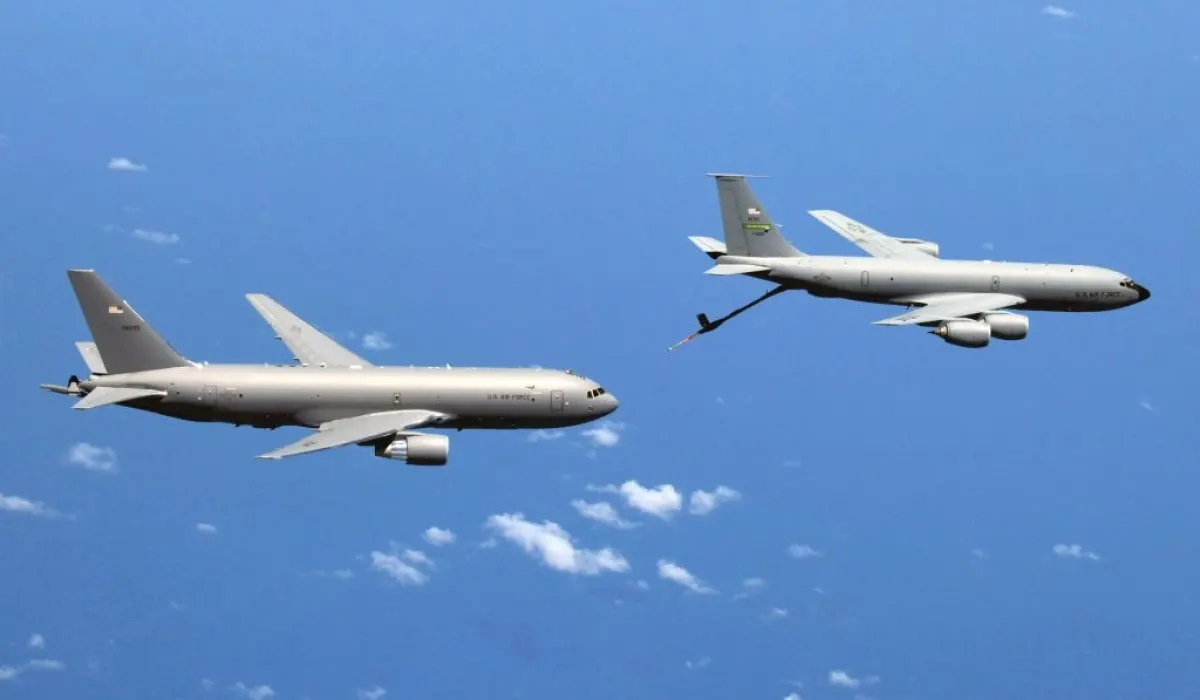
- The war begins on the tarmac, before the refueling trucks arrive.
- Hangar 60 is not a minor addition to the aircraft business.
- The problems revealed in the Middle East are smaller than those in China, but they are by no means insignificant.
- There is a gap between the current state of the KC-46 and the future with blended wing body technology.
- First, what the United States needs to ensure is the viability of the fuel supply chain, not simply acquire new refueling vehicles.
- Here are three things to check in the next budget and during the first flight:
- Frequently Asked Questions.
The war begins on the tarmac, before the refueling trucks arrive.
Fighter jets can be shot down in the air, but tankers can lose the war before they even take off, stuck on the apron. The 373 KC-135 Stratotankers and 103 KC-46A Pegasus aircraft of the U.S. Air Force support America’s long-range operations, but they struggle to escape from long runways, large aprons, and extensive fuel facilities.
Therefore, the core of this debate is not about how many new tanker aircraft to purchase. The question is whether tanker aircraft, which would be the first targets for missiles and drones in forward operating bases, can survive in the event of a high-intensity conflict with China.
The Hudson Institute recommended a package that includes at least 60 hardened aircraft shelters (HAS), distributed fuel facilities, access to airfields in allied countries, improvements to the communication and self-defense capabilities of existing tanker aircraft, and the procurement of medium-sized blended wing body (BWB) tanker aircraft. While it appears to be a report on tanker aircraft procurement, it is actually a warning that the United States’ ability to sustain warfare could be compromised by runways and fuel tanks.
Hangar 60 is not a minor addition to the aircraft business.
The apparent issue is the construction of aircraft hangars. The Hudson Institute estimated that building a minimum of 60 large, reinforced aircraft hangars over a 10-year program would cost $3,060,000,000. The cost per hangar ranges from $30,000,000 to $150,000,000, depending on the location and level of protection.
The actual issue is a dispute over budget priorities. The U.S. Air Force has requested $3,900,000,000 in the FY2027 budget to purchase 15 KC-46A aircraft. This means the estimated cost of 60 aircraft hangars is comparable to the cost of purchasing 15 tanker aircraft. The fundamental question is whether a portion of the budget allocated for purchasing more aircraft can be redirected to improve base survivability.
These numbers do not indicate that hangars are inexpensive. Even building just hangars requires separate solutions for runway repair, power supply, fuel distribution, decoys, short-range air defense, and maintenance facilities. One cannot win a war with just a concrete wall. However, large aircraft lined up on the ground make the enemy’s target list excessively clear.
Kenneth Wilsbach, the U.S. Air Force Chief of Staff, offers a different calculation. He stated that unless the depth is more than 100 feet, hangars could also be destroyed, and that active air defense and low-cost anti-drone defense should be prioritized. “I believe that cost-effectiveness lies more in defending the air and ground with systems that can intercept incoming projectiles than in building hangars.”
That counterargument is valid. The hardened hangar is not invulnerable to ballistic and cruise missiles with high penetration power, and the estimated cost of 3,060,000,000 US dollars may not sufficiently account for factors such as soil conditions at overseas bases, operational downtime during construction, and negotiation costs with the host country. However, active defense systems cannot block all projectiles. The premise of choosing only between a shield and a wall is an overly simplistic question.
The problems revealed in the Middle East are smaller than those in China, but they are by no means insignificant.
The Hudson Institute’s report is aimed at deterring China, but the timing of its release coincides with combat damage in the Middle East. In March 2026, reports emerged that an Iranian attack on Prince Sultan Air Base (Prince Sultan Air Base, PSAB) in Saudi Arabia damaged a U.S. military tanker aircraft, and in September, reports emerged that one A-10 and approximately eight F-15s were damaged at Muwaffaq Salti Air Base (Muwaffaq Salti Air Base) in Jordan.
The exact number of KC-135 aircraft damaged and the precise timing of the damage at Prince Sultan Air Base vary depending on the source. The final assessment of losses for the E-3 Sentry aircraft has not been consistently confirmed based on publicly available information. Nevertheless, the fact that exposed aircraft actually took hits remains unchanged. Even with a limited attack, if the base was destabilized, then in the Indo-Pacific region, where China’s reconnaissance and missile networks are present, the loss of even a single tanker aircraft should be calculated not just as the loss of that one aircraft, but as a potential disruption of the entire tanker network.
The scene described by Daniel H. Turley, commander of the Air Mobility Command (AMC), encapsulates this issue. “The KC-135 operational crew was on the aircraft, and the maintenance team was just about to launch it. An unexpected red alert—in other words, an attack warning—sounded, and everyone rushed into the bunker.” Before it is a flying fuel tank, a tanker is a massive fixed asset on the ground that consumes maintenance and fuel.
The direct impact on South Korea is not significant. This report did not directly address South Korean bases, budgets, or procurement projects. However, in the event of a crisis on the Korean Peninsula, the operational range of U.S. Air Force units stationed in South Korea and Japan and South Korean Air Force fighter jets depends on aerial refueling. The inclusion of KC-135 aircraft in the distributed refueling and base defense training exercises at Gunsan Air Base in April 2026 is also related to this. An ally’s runway is not simply a space that is lent; it becomes a strategic asset that shares the risks of missile threats and the costs of fuel and air defense.
There is a gap between the current state of the KC-46 and the future with blended wing body technology.
The U.S. Air Force will continue to procure KC-46A aircraft immediately. At the same time, funding for the Next-Generation Air-refueling System (NGAS) research has been removed from the FY2027 budget proposal, while $13,000,000 has been requested for Advanced Tanker Systems (ATS), which will address communication, self-defense, and unmanned operation capabilities for existing tanker aircraft.
Rather than abandoning innovation in tanker design, this is closer to a measure that addresses the immediate capability gap while keeping a limited set of future options open. The U.S. Air Force retired 59 KC-10 Extenders between FY2019 and FY2025, and the U.S. Government Accountability Office pointed out that in October 2026 it had neither comprehensively assessed the sustainment risks of the KC-135 and KC-46 nor developed a prioritized mitigation plan.
The Hudson Institute claims that 250 medium-sized BWB (Blended Wing Body) tanker aircraft could save $15,500,000,000 over 30 years compared to 250 KC-46A aircraft, and could increase the amount of fuel available for refueling by 58%. This is based on the calculation that they can carry more fuel and reach operational orbits from more distant bases. However, these figures are the results of a model using 32 scenarios and a representative design.
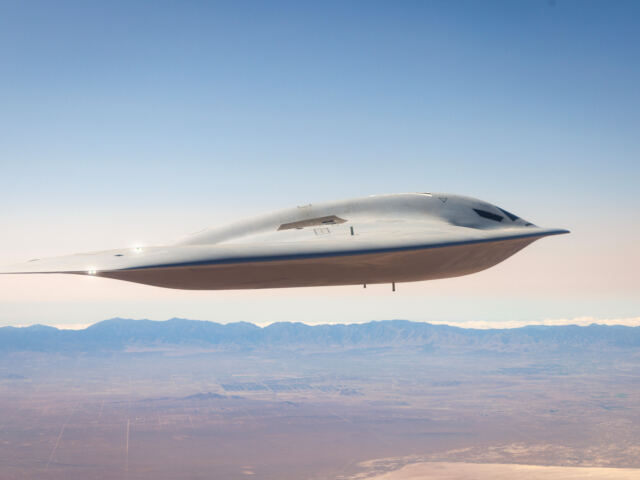
JetZero’s blended wing body (BWB) prototype was selected in 2023 for support from the U.S. Air Force, and initial flight testing is targeted for as early as 2027. The U.S. Department of Defense has decided to invest $235 million over four years to accelerate development. Prototype flight testing, integration of military refueling equipment, and survivability verification still remain. Blending the wings and fuselage does not mean the timeline is blended as well.
First, what the United States needs to ensure is the viability of the fuel supply chain, not simply acquire new refueling vehicles.
I believe that the core diagnosis of the Hudson Institute is correct. The problem that the United States must address first is not whether to purchase additional KC-46A aircraft or to switch to a blended wing body design, but rather ensuring that the existing tanker aircraft can survive at the base and be able to take off.
There are two reasons for this. First, the proposed hangar, with a cost of 3,060,000,000 US dollars, is equivalent to the requested amount of 3,900,000,000 US dollars for the purchase of 15 KC-46A aircraft. The selection of a certain number of platforms and investment in infrastructure are not unrelated accounts, but rather represent funds competing for the same war-sustaining capability. Second, refueling aircraft and fighter jets deployed in the Middle East have been damaged, and the U.S. Government Accountability Office has pointed out the lack of a comprehensive risk mitigation plan for the the sustainment of current tanker aircraft. The current maintenance, fuel, and protection systems are faltering before the performance specifications of future refueling aircraft.
If my assessment is incorrect, it is likely because the United States can deter the targeting and damage to forward operating bases by combining dispersal, deception, and active defense, at a cost far lower than that of hangars. Therefore, Wilsbach’s counterargument cannot be dismissed lightly. However, it is difficult to consider hangars a luxury item until the alternative is proven through budget allocation, training, and actual deployment.
Here are three things to check in the next budget and during the first flight:
- The $13,000,000 for Advanced Tanker Systems will be spent during FY2027. Where it is used—among communications, electronic warfare, self-defense, and unmanned operations—reveals what the U.S. Air Force considers most critical for short-term survivability.
- Whether the contract for the extended production of an additional 75 KC-46A aircraft will be finalized by the end of 2026 or in 2027 reveals which of the two risks the U.S. Air Force is paying the higher insurance premium to cover: the current quantity shortfall or the risks of BWB (Blended Wing Body) development.
- The planned first flight of the JetZero BWB demonstrator, scheduled as early as 2027, along with the plan to integrate military refueling equipment, represents the first crucial step to determine whether the model, which projects a 30-year cost savings of $15,500,000,000 and a 58% increase in refuelable fuel capacity, can be successfully translated into a real aircraft.
Frequently Asked Questions.
What is the construction cost for 60 hardened aircraft hangars?
The Hudson Institute estimated that a 10-year construction program, based on a minimum of 60 buildings, would cost at least $3,060,000,000. The estimated cost per building ranges from $30,000,000 to $150,000,000, depending on the location and scope of the project.
How many tanker aircraft does the U.S. Air Force currently have in its inventory?
As of early March 2026, the inventory included 373 KC-135 aircraft and 103 KC-46A aircraft. The U.S. Air Force decommissioned 59 KC-10 aircraft between fiscal years 2019 and 2025.
Is the blended wing body refueling aircraft already in operation?
It is not. The initial flight tests for the JetZero BWB prototype aircraft are tentatively scheduled for as early as 2027. The schedule for integrating military refueling equipment and conducting survivability tests has not been finalized.
Representative photo — U.S. Air Force · USAF
This is a work of the U.S. federal government and is in the public domain. The use of U.S. Department of Defense visual materials does not imply endorsement by the U.S. Department of Defense.