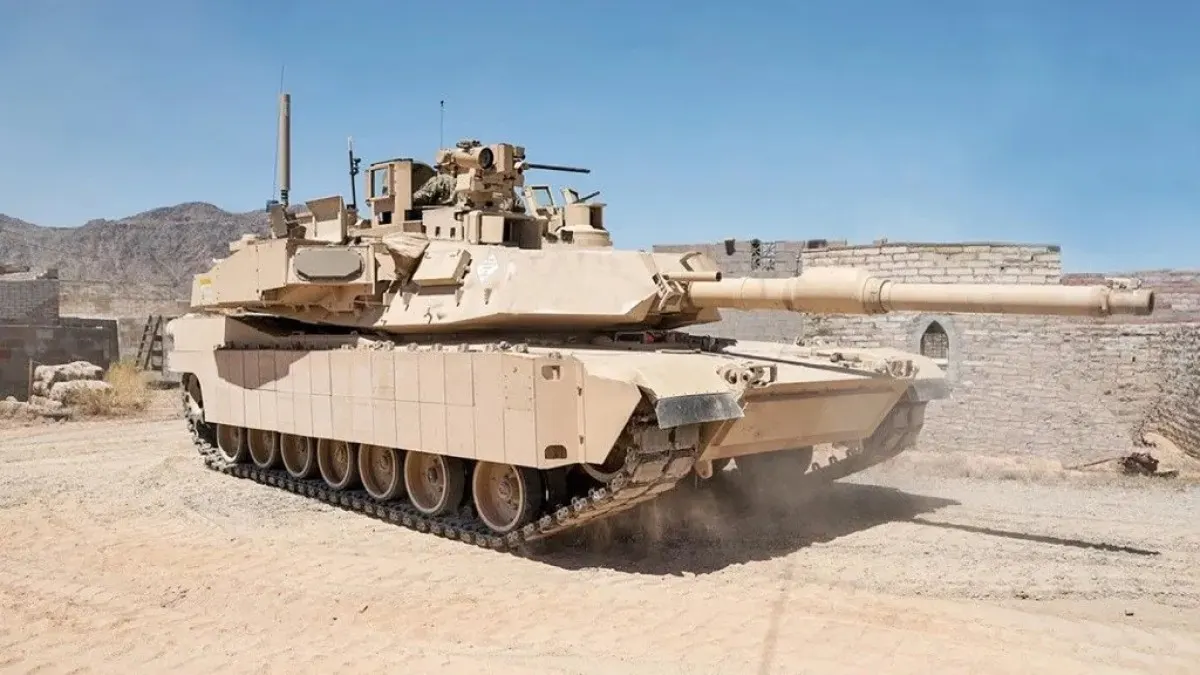
- The 34-ton tank fired not only shells.
- What costs more than a single tank are the assembly rights and maintenance rights.
- The price list for the lightweight 120mm guns does not yet include the costs associated with drone warfare.
- Slovakia’s decision will determine the size of the ecosystem, rather than the caliber of the weapon.
- The target that Carpatia is aiming for is not the Slovakian tank battalion, but rather the gateway to the European supply chain.
- The following three signals will indicate the direction of the contract.
- Frequently Asked Questions.
- Karpat has already been adopted by the Slovakian military
- What kind of tank is the Carpat?
- What is the combat weight of the Carpat?
The 34-ton tank fired not only shells.
A tank, mounted with a 120mm gun on a 34-ton chassis, was running on the military testing ground in Zahorie, Slovakia, and firing at targets. However, the document signed on that day was not a purchase contract, but a memorandum of understanding for publicity, sales, and production cooperation of the turret. What was actually moving in the place where the sound of gunfire was heard was not the procurement budget, but the European defense production rights.
The CSG group, along with Türkiye’s FNSS and Italy’s Leonardo, has combined to produce the CFL-120 Karpat medium tank, which was publicly demonstrated for the first time on November 19, showcasing its off-road maneuverability and live firing capabilities. This vehicle, boasting a maximum weight of 34 tons, a speed of 70 km/h, and a range of approximately 450 km, is designed for countries seeking a more affordable and lighter 120mm direct fire weapon system than a main battle tank.
However, this event is not a contract announcement. Details such as the purchasing country, contract quantity, price per vehicle, and mass production schedule were not disclosed. While discussions about the T-72 series successor tank in Slovakia were underway, the Karpat camp was the first to showcase the actual vehicle and tie together its production network.
What costs more than a single tank are the assembly rights and maintenance rights.
On the surface, it appears as if the three companies are jointly developing the system, each contributing their respective strengths. The Karpat utilizes the chassis of the Kaplan MT medium tank and incorporates the HITFACT MkII turret, with CSG and MSM Land Systems of Slovakia responsible for production and integration.
In reality, the work involves establishing sales channels for Türkiye-designed products within Europe. CSG Defence has reached an agreement with FNSS on the framework for establishing Danube Defence Systems, headquartered in Trencin. The anticipated shareholding is 51% for CSG Defence and 49% for FNSS. While FNSS provides the chassis technology, CSG holds a greater share of the key aspects of manufacturing and sales.
The memorandum of understanding with Leonardo also points in the same direction, encompassing not only the supply of turrets but also publicity, sales, and production. In the defense industry, local production does not end with a few factory photos. The crucial question remains: who will occupy each seat at the negotiation table for parts procurement, maintenance, subsequent improvements, and export approvals.
The Kaplan MT series is a 105mm medium tank that has been mass-produced and delivered to the Indonesian Army. The 2019 contract between FNSS and PT Pindad involved 18 Kaplan MT tanks, and FNSS announced the completion of delivery in 2024. In contrast, the Karpat, which is equipped with a 120mm turret, has not yet secured any mass production contracts or operational records with the military. There is a significant gap between the statement that it is a new combination on a proven chassis and the statement that the complete system has been validated.
The price list for the lightweight 120mm guns does not yet include the costs associated with drone warfare.
The Slovakian Department of Defense has a clear reason for considering this category. Minister of Defense Robert Kalinák stated that, considering the mountainous terrain and bridge load capacity, they are reviewing the 40-ton class rather than the 70-ton class of main battle tanks. The comparison criteria he presented are straightforward. The new Leopard costs 30,000,000 euros, while the basic model of the 40-ton class light tank costs approximately 12,000,000 euros.
However, the base price is not the final price. Karpats has only announced that it is possible to integrate modular add-on armor, a laser warning system, and an Active Protection System (APS). It has not yet been confirmed which protective packages were actually installed on the demonstration vehicle, whether tests were conducted to counter drone and anti-tank guided missile threats, or how the weight and price change after adding the protective equipment.
The war in Ukraine is not a war that has sent tanks to museums. While the number of Russian tanks detected within 70 kilometers of the front lines has significantly decreased compared to 2023, it is still assessed that tank platoons are needed for fire support and infantry protection. However, tanks are no longer the main actors that can advance alone; they have become expensive team players that must be integrated with reconnaissance, electronic warfare, air defense, and infantry to operate effectively.
The direct impact on South Korea is not significant. There is no evidence that South Korean companies are participating in the Carpat project. However, the questions that the K2 series and South Korean armored vehicles will face in the European market will become clearer in the future. It is likely that the key factors in the contract will be not whether a 120mm gun can be mounted, but rather how much production can be transferred locally, and what weight and price conditions are offered for APS (Active Protection System) and drone countermeasures equipment.
Slovakia’s decision will determine the size of the ecosystem, rather than the caliber of the weapon.
The most direct competitor to the Carpat is not a Russian tank, but the CV90120 MkIV light tank/direct fire support system. BAE Systems Hagglunds offers this vehicle, which weighs up to 38 tons, equipped with a 120mm low-recoil gun, an automatic loading system, an APS (Active Protection System), and a crew of 3. The fact that Slovakia is already in the process of adopting the CV9035 MkIV is a significant factor, more important than simple specifications.
The Carpat boasts a maximum weight of 34 tons and emphasizes its local production setup. The CV90120 can highlight its commonality with the CV90 family in terms of maintenance, training, and parts, as well as its automatic loading system and APS (Advanced Protection System). There are no official comparative test results to determine which vehicle is superior, and data comparing the two vehicles under the same protection configuration and price conditions has not been publicly released.
The U.S. Army’s decision to terminate the low-rate initial production contract for the M10 Booker Combat Vehicle in 2025 and not proceed to full-scale production is also a warning sign for this market. Simply stating that it is lighter than a main battle tank is not enough. It is necessary to answer questions such as which units will use it for what missions, how it will be transported, and who will recover lost vehicles and when. Reducing the weight of a tank does not automatically make the procurement process easier.
The target that Carpatia is aiming for is not the Slovakian tank battalion, but rather the gateway to the European supply chain.
I believe that Karpats’ immediate goal is not simply to outperform competitors based on tank performance alone, but to establish a European business foothold with Slovakia as its base, encompassing vehicle bodies, turrets, and maintenance services. First, the most concrete outcome of this unveiling was not a purchase contract, but a memorandum of understanding for turret sales and production cooperation with Leonardo. Second, the structure in which CSG anticipates a 51% stake in Danube Defence Systems indicates a design aimed at leading manufacturing and sales, rather than simple assembly subcontracting.
For the Karpat to achieve actual fielding, it must first address the shortcomings in its survivability, rather than focusing on promotional slogans for the turret. Data must be provided on how APS (Active Protection System) and additional armor are configured, what the resulting price and weight are, and how long it can withstand threats from drones and anti-tank missiles. Currently, the Karpat is more like a problem set distributed to European customers than a complete solution.
If my assessment is wrong, it will be because Slovakia soon formalizes the program’s quantity, budget, and requirements, selects Carpath, and then releases both the test data for vehicles equipped with an APS and a protection package and a mass-production contract. At that point, I would have to revise my assessment: it would be a production network for tanks, not a tank for a production network.
The following three signals will indicate the direction of the contract.
- It remains to be seen whether Slovakia’s Ministry of Defence will disclose the quantity, budget, requirements, candidate models, and selection schedule in the 2027 defense budget, mid-term acquisition plan, or procurement announcement. This indicates whether the review stage has progressed to an actual acquisition project.
- The key factors for the future will be whether Karpat demonstrates its prototype vehicle equipped with APS (Active Protection System), additional armor, and an automatic loading system at test sites and European defense exhibitions, and whether it presents materials related to drone and anti-tank missile countermeasures there. This signifies a shift from the concept of “light firepower” to a survival package.
- Within the next 6 to 18 months, it is necessary to confirm whether the establishment of Danube Defense Systems as a legal entity, investment in production lines, and its first production or export contract will be announced. This will determine whether this collaboration goes beyond a memorandum of understanding for the exhibition and becomes a real supply chain.
Frequently Asked Questions.
Karpat has already been adopted by the Slovakian military
That is not correct. The Slovakian government’s official selection result, project quantity, budget, and contract schedule have not been disclosed.
What kind of tank is the Carpat?
This 120mm medium tank combines the Kaplan series chassis from Türkiye’s FNSS, the Hitfact MkII turret from Italy’s Leonardo, and the production and integration capabilities of CSG·MSM from Slovakia.
What is the combat weight of the Carpat?
The combat weight disclosed by CSG is up to 34 tons. However, the actual weight may vary depending on the protective equipment and the configuration of the installed components.
Representative photo — U.S. Army
This is a work of the U.S. federal government (public domain). The use of visual materials from the U.S. Department of Defense does not imply endorsement by the Department of Defense.