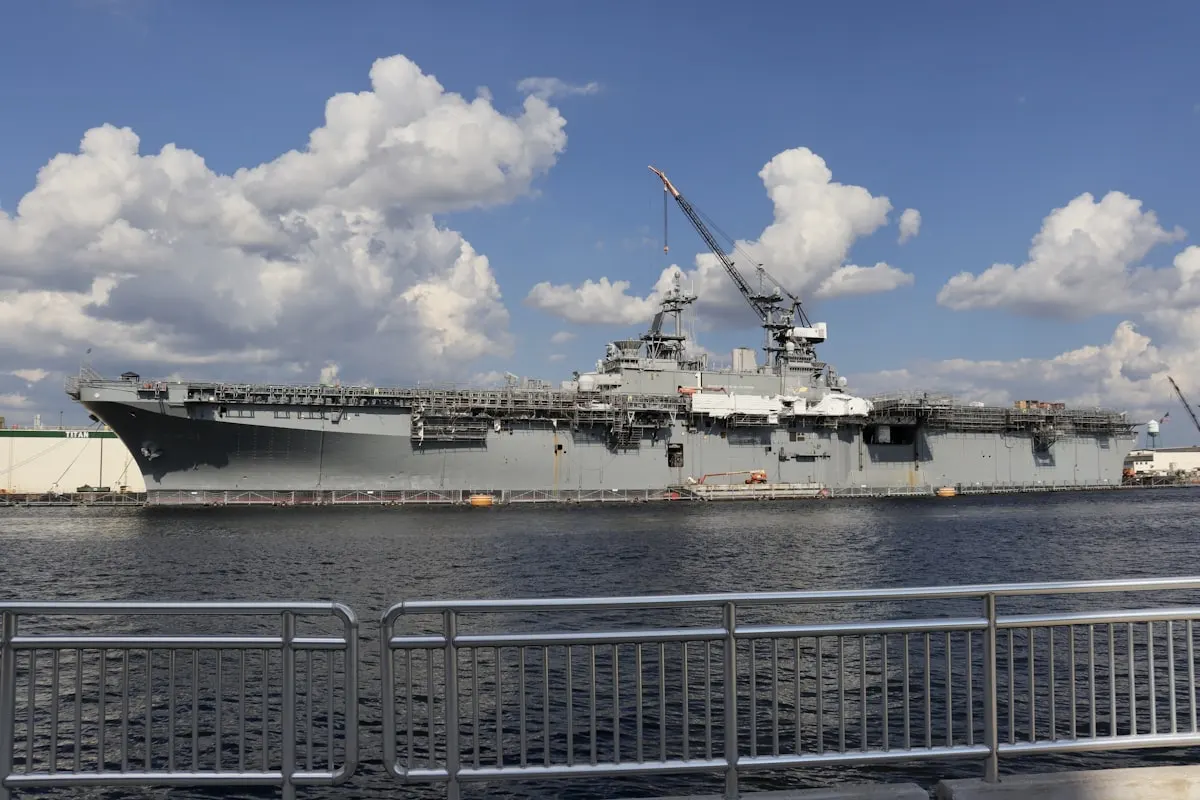
Preliminary design work begins for a nuclear submarine dry dock in Western Australia
The Australian government has selected Leidos subsidiary Gibbs & Cox Australia as the preliminary design contractor for an emergency response dry dock for nuclear-powered submarines. This facility, to be built in Western Australia, is a crucial maintenance infrastructure that Australia must have in place before acquiring Virginia-class submarines under the AUKUS plan.
According to a statement released by the Australian Ministry of Defence on July 29, 2026, Gibbs & Cox Australia is leading the design of a floating dry dock that can lift submarines out of the water. The specific design contract amount and the dry dock’s specifications have not been disclosed.
Roles of a floating dry dock
A dry dock is a facility used to inspect the hull and underwater equipment of a submarine, and to perform necessary repairs. This project focuses on establishing an emergency response capability to dock submarines in urgent or unforeseen situations, rather than serving as a large shipyard that handles all routine maintenance during peacetime.
The Australian government plans to prepare a floating dry dock starting in the early 2030s to enable the performance of major repairs and maintenance on its nuclear-powered submarines. Subsequently, in the late 2030s, the government intends to establish capabilities for long-term disassembly, inspection, and overhaul of submarines.
The related facilities are planned to be designed and operated in accordance with Australia’s domestic permitting procedures, nuclear safety regulations, and non-proliferation obligations. Because it will handle nuclear-powered submarines, a higher level of safety, security, and quality control system is required compared to dry docks for conventional vessels.
Key prerequisites for the acquisition of Virginia-class submarines
The Australian government has stipulated that a comprehensive emergency response plan is a key prerequisite for the acquisition of the first Virginia-class submarine. According to the Australian Submarine Agency, the United States plans to transfer three Virginia-class nuclear-powered submarines to Australia starting in the early 2030s, with the possibility of acquiring up to two additional submarines if needed.
The United States Congress approved the transfer of three Virginia-class submarines in December 2023. These submarines will help fill the capability gap between Australia’s existing Collins-class submarines and the next-generation nuclear-powered submarines (SSN-AUKUS) until the latter are deployed.
- In 2027: The SRF-West, a rotational deployment of U.S. and UK nuclear-powered submarines, is scheduled to begin from HMAS Stirling.
- Early 2030s: Australia is scheduled to receive its first Virginia-class submarine from the United States.
- Late 2030s: Australia plans to establish nuclear submarine maintenance capabilities.
- Early 2040s: The target date for the delivery of the first SSN-AUKUS class submarines, built in Australia.
Maintenance infrastructure focused on Henderson and HMAS Stirling
This dry dock project is part of a plan to expand submarine operation and maintenance infrastructure, centered around the Henderson Defense Precinct in Western Australia and HMAS Stirling. HMAS Stirling will become a key submarine base for the Royal Australian Navy, operating the Virginia-class and the SSN-AUKUS class submarines.
The Australian government stated that the Dry Dock design is based on the initial investment of 12 billion Australian dollars for the development of the Henderson Defense Precinct. This investment aims to integrate shipbuilding, maintenance, and nuclear-powered submarine maintenance facilities, and is expected to support approximately 10,000 direct jobs in Western Australia over the next 20 years.
However, the maintenance facilities in Western Australia have a different role than the Osborne submarine construction yard in South Australia. While ASC and BAE Systems are building the Australian SSN-AUKUS class submarines at Osborne, the facilities in Western Australia are responsible for the deployment and maintenance of nuclear-powered submarines, including the Virginia class.
What kind of company is Gibbs & Cox Australia?
Gibbs & Cox Australia is the Australian subsidiary of Gibbs & Cox, which provides ship design, marine engineering, nuclear submarine engineering, and shipbuilding and maintenance facility design services. Leidos acquired the U.S. ship design company Gibbs & Cox in 2021 and integrated it into its maritime systems business.
With this selection, Gibbs & Cox Australia will lead the requirements analysis and preliminary design for the floating dry dock. In the future, as the design is refined, and as permitting, construction, and commissioning phases proceed, the involvement of Australian companies in the supply of equipment and the training of personnel in the fields of nuclear safety and maintenance is expected to increase.
Frequently Asked Questions (FAQ)
Where will the Australian nuclear submarine dry dock be constructed?
The Australian government plans to establish a floating emergency dry dock in Western Australia. While the specific location has not been disclosed, the project will be linked to the nuclear-powered submarine maintenance infrastructure centered around the Henderson Defense Precinct and HMAS Stirling.
Is this dry dock also used for submarine construction?
The primary purpose of this project is to expand the emergency docking capabilities for the urgent repair and maintenance of nuclear-powered submarines. The construction of the Australian SSN-AUKUS class submarines will take place at the Osborne Naval Shipyard in South Australia.
How many Virginia-class submarines will Australia acquire?
The United States plans to transfer three Virginia-class submarines to Australia starting in the early 2030s. Australia may acquire up to two additional submarines, subject to further approval from the U.S. Congress if needed.
What is the reason why Australia needs to secure a dry dock first?
To independently operate nuclear-powered submarines, it is necessary to have domestic docking and repair facilities that can respond to malfunctions or emergencies. The Australian government considers this a key prerequisite for the acquisition of the first Virginia-class submarine.
Are AUKUS and SSN-AUKUS the same thing?
AUKUS is a security cooperation framework between Australia, the United Kingdom, and the United States. The SSN-AUKUS is a next-generation nuclear-powered attack submarine that combines the technologies of the three countries, to be adopted by the United Kingdom and Australia.