U.S. Marine Corps Completes Final MV-22 Osprey Acquisition
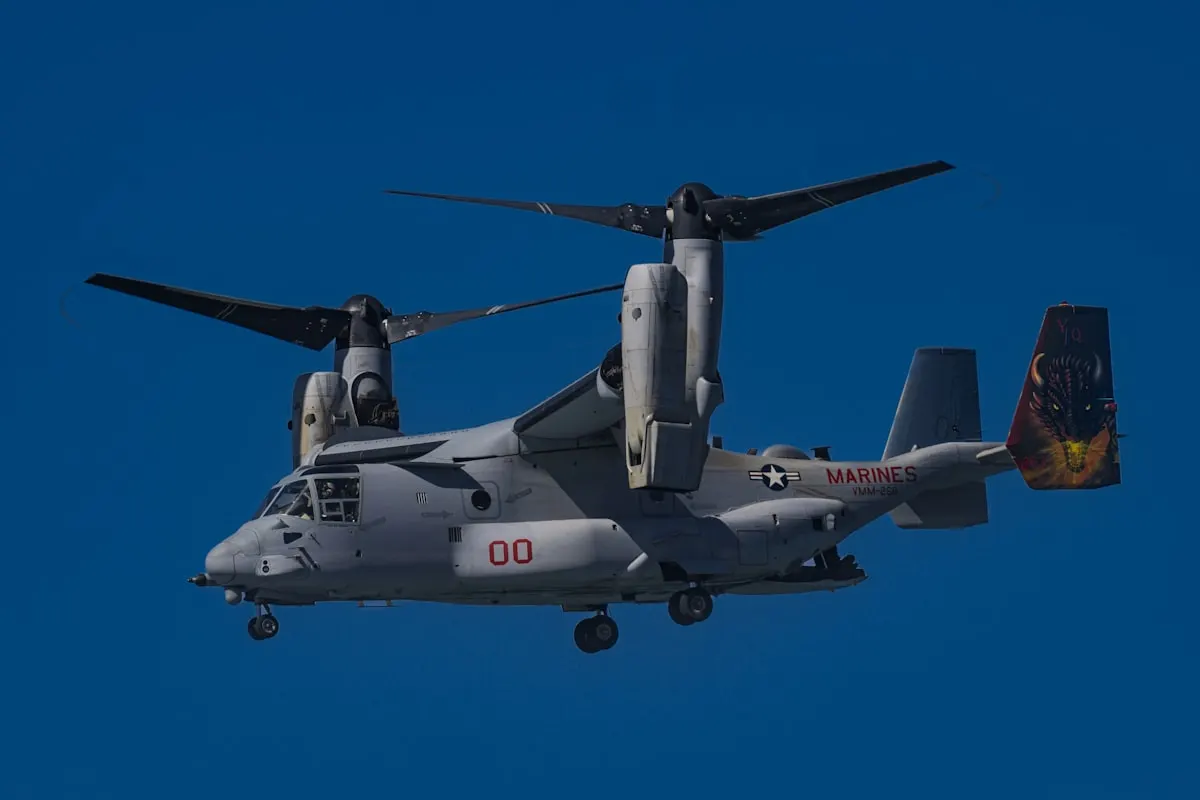
On July 28th, the United States Marine Corps (USMC) received the last MV-22 Osprey aircraft. With the acquisition of a total of 359 tiltrotor aircraft, the Marine Corps plans to operate them in active service until 2055. The MV-22 Osprey has a unique design that allows for vertical takeoff and high-speed horizontal flight, and it has contributed significantly to improving the operational efficiency of the Marine Corps.
Background of the MV-22 Osprey’s technological development
The MV-22B is an aircraft jointly developed by Bell and Boeing. The Bell-Boeing V-22 Osprey is a U.S. multi-purpose tiltrotor military transport aircraft with vertical takeoff and landing (VTOL) and short takeoff and landing (STOL) capabilities. It is designed to combine the functionality of helicopters with the long-range and high-speed flight performance of turboprop aircraft. The MV-22B achieved initial operational capability (IOC) in June 2007.
Key role in Marine Corps operations
Since acquiring initial operational capability in early 2007, the Marine Corps’ MV-22B fleet has flown over 680,000 hours in 114 operational deployments. Currently, the Osprey accounts for 75% of the Marine Corps’ rotary-wing close air support. This aircraft can transport 24 personnel (seated), 32 personnel (on the floor), or 9,070 kg of internal cargo or 6,800 kg of external cargo.
The MV-22 has fundamentally changed the Marine Corps’ amphibious assault capabilities by enabling rapid troop deployment in combat zones and transportation from ships to coastal areas. This multi-purpose platform supports a wide range of missions from forward operating bases around the world, including combat operations, rapid resupply, medical evacuation, and humanitarian assistance.
Modernization plans up to 2055
The Marine Corps is focusing on “reducing maintenance time through nacelle wiring improvements, pursuing an improved propeller gearbox using triple-melt refined steel components, standardizing aircraft configurations across the entire fleet, and redesigning key components to enhance safety and sustainability.” The Marine Corps MV-22B fleet has reportedly flown over 680,000 hours across 114 operational deployments.
With the final acquisition of the Osprey, the Marine Corps has begun to shift its focus from aircraft deployment to sustained operations and fleet evolution. This modernization effort aims to maintain the operational effectiveness of the Osprey for more than 30 years and to prepare for a wide range of future military operations.
Future outlook
The completion of the MV-22 acquisition signifies a strengthening of the Marine Corps’ airlift capabilities. While the Osprey fleet is expected to continue operating until 2055, the Marine Corps is considering a replacement aircraft, designated as the Next Generation Attack/Support (NGAS) aircraft. Currently, the Osprey remains a core operational asset for the Marine Corps and is expected to play a crucial role in various military operations.
Frequently Asked Questions (FAQ)
Q. What is the purpose of the MV-22 Osprey?
The MV-22 Osprey is used in a variety of military operations, including troop and cargo transport, medical evacuation, and search and rescue missions. Its primary role is to rapidly transport Marine Corps personnel from ships to coastal areas.
Q. What is the operational lifespan of the MV-22 Osprey?
The MV-22 Osprey has been in service since 2007 and is scheduled to remain active until 2055. Therefore, it is a long-serving aircraft with a planned operational lifespan of over 50 years.
Q. How many personnel can the MV-22 Osprey transport at one time?
The standard configuration allows for the transport of 24 Marine Corps personnel with full combat gear in the seats, and up to 32 personnel can be transported if they are loaded on the floor.
Q. What are the main features of the MV-22 Osprey?
The MV-22 Osprey is a tiltrotor aircraft that can take off and land vertically like a helicopter, while also being capable of high-speed cruising like a fixed-wing aircraft. This allows it to be operated in areas without runways, and it can fly at a speed twice as fast and a distance five times longer than conventional helicopters.
Q. What does the completion of the Osprey acquisition mean?
A. This means that the Marine Corps has acquired all 359 of the MV-22 Osprey aircraft it needs. From now on, the focus will be on modernizing and maintaining the existing fleet, rather than purchasing new aircraft.
Q. Do other countries operate the MV-22 Osprey?
A. Yes, Japan is the only international operator of the MV-22 Osprey. In addition to the United States, the U.S. Air Force Special Operations Command (AFSOC) also operates the CV-22 variant.