- The nature of the space that is larger than 96 missiles.
- The anti-air warfare ship has been transformed into a drone carrier.
- While the Horizon-class ship is being repaired, I am writing the rules for the next trap.
- The competition between lasers and railguns is decided in the power plant.
- The Naval Group’s goal is not to secure a contract for a single submarine, but rather to obtain the design specifications for the next war.
- You must observe the following three signals.
- Frequently Asked Questions.
- Is SCX26 a type of vessel that the French Navy plans to build?
- What is the SCX26’s primary armament?
- Is this project directly linked to South Korea?
The nature of the space that is larger than 96 missiles.
The most notable feature of the combat ship, which proposes 96 missiles, is not the launch tubes themselves, but the empty space inside the stern. This area is designed for a variety of tasks, including deploying, recovering, repairing, and even manufacturing components for drones. This envisions a future destroyer where the space beneath the deck serves as both an armory and a maintenance facility.
The French company Naval Group unveiled the SCX26 at Euronaval in Paris on November 3, 2026. This large surface combat vessel, with a length of 170 meters, a width of 24 meters, and a full load displacement of 8,000 to 10,000 tons, is designed to operate and maintain unmanned aerial vehicles, unmanned surface vehicles (USVs), and unmanned underwater vehicles from a single ship.
However, this is neither a procurement decision by the French Navy nor a construction contract. It is a research and design study by Naval Group that first outlines the requirements for high-intensity naval warfare in the 2040s. Although this is a ship without a price, a customer, or a construction schedule, the very concept itself reveals the objective of this announcement.
The anti-air warfare ship has been transformed into a drone carrier.
Externally, the SCX26 resembles a large air defense destroyer. It is equipped with 12 Sylver vertical launch systems, capable of carrying up to 96 missiles, a 100kW laser, and an electromagnetic railgun. It boasts a speed of 30 knots and a range of 8,000 nautical miles. The crew is planned to consist of approximately 150 personnel, with the capacity to accommodate an additional 100.
However, the actual design focuses more on the drone’s operational cycle than the number of missiles. It includes facilities for launching, recovering, and maintaining unmanned systems within the ship’s interior and on the flight deck, and even considers the possibility of using additive manufacturing to produce components. The key is not how many drones are carried, but rather whether damaged drones can be revived and redeployed for new missions over several days, which will determine combat effectiveness in the era we are targeting.
The French Navy conducted a test in the Mediterranean Sea off Toulon in April 2025, in which an unmanned surface vessel struck and detonated a decommissioned landing craft. The French Department of Defense explained the objective of this experiment as: “The objective of this experiment was to verify the French Navy’s ability to deploy remotely operated naval munitions at sea.” The concept of using drones like the SCX26 is not just a buzzword at trade shows.
Simply because a ship is called a “drone mothership” does not mean its sustained combat capability is proven. The number of drones carried, the daily launch rate, the sea conditions under which they can be recovered, the amount of spare parts and ammunition resupplied, and the level of data link performance in electronic warfare situations have not been disclosed. There is a significant difference, often thicker than an entire budget document, between the statement that there is a maintenance facility and the statement that the maintenance facility is operational during wartime.
The direct connection with South Korea is not significant. There are no confirmed contracts or joint development projects involving South Korean companies or the South Korean Navy in the SCX26 program. However, if the requirements for the export surface combatant market solidify to include manned and unmanned operations, as well as drone maintenance and command spaces, it is possible that the next-generation destroyer designs from the South Korean shipbuilding and defense industries will not be evaluated solely based on the number of missile launch tubes.
While the Horizon-class ship is being repaired, I am writing the rules for the next trap.
France and Italy signed a contract in 2023 for the modernization of four Horizon-class air-defense frigates, with a total value of 1,500,000,000 euros. The delivery of the modernized ships is scheduled from the end of 2027 to the end of 2030, and will include the installation of new long-range active electronically scanned array (AESA) radars and the modernization of the PAAMS air defense system.
On the surface, this project appears to be an effort to extend the service life of existing warships. However, it is also an industrial race to seize the initiative in defining demand for the next generation of warships. While the Horizon-class ships are expected to maintain their top-tier air defense capabilities until 2040, Naval Group has already proposed what the subsequent generation of warships should possess.
The SCX26 has not been officially confirmed as the French Navy’s follow-on ship design. Nevertheless, Naval Group has reason to be first to put forward an answer. France’s 2024-2030 military planning law prioritizes rearmament, artificial intelligence, air defense, and anti-drone capabilities, with a budget of 413,000,000,000 euros. If drone operation areas, distributed sensors, and anti-air missile density are included as requirements when the next budget is allocated, the negotiating power of shipyards and combat system companies will change.
This ship incorporates a survivability philosophy with two superstructures and a distributed sensor system. The design aims to ensure that even if one area is hit, the ship can maintain its combat functions. However, integrating command, air defense, and drone support into a single hull of 8,000 to 10,000 tons means that the ship becomes a critical node for friendly forces and a primary target for the enemy. A distributed design does not necessarily mean a distributed risk.
The competition between lasers and railguns is decided in the power plant.
In the promotional images, the most prominent equipment includes a 100kW laser and an electromagnetic railgun. However, the more critical question for actual combat vessels is not how bright the laser is, but rather how long it can sustain its power and cooling. While the weapon may be mounted on the deck, its performance can be compromised by the engine room and cooling piping.
SCX26 did not disclose the caliber, effective range, sustained firing capability, barrel lifespan, and power/cooling requirements of the electromagnetic railgun. The actual combat performance data for the 100kW laser was also not provided. While Japan successfully used a ship-based electromagnetic railgun to fire at an actual target vessel from the test ship Asuka in 2025, this is not a shipborne gun system that has been deployed for actual combat.
Lasers can be useful for small drones and close-range target engagement, but they are subject to limitations related to weather conditions, distance, aiming stability, and heat management. They should not be considered as a replacement for missile defense systems. The proposed configuration of 12 Sylver vertical launch systems for the SCX26, capable of carrying a maximum of 96 missiles, represents the upper limit, and the actual missile composition and launcher configuration have not yet been finalized.
The Naval Group’s goal is not to secure a contract for a single submarine, but rather to obtain the design specifications for the next war.
The author believes that the primary goal of the SCX26 project is not to immediately sell a single warship, but rather to define, in a manner similar to the Naval Group’s approach, the questions that must be answered regarding the budgets for the next-generation large surface combatant ships for France and Europe. First, this concept lacks specific details such as price, development costs, the number of ships to be built, and the customer. It is closer to an industrial claim on future requirements than to a bid proposal.
Secondly, while the Horizon-class modernization project already has a contract worth 1,500,000,000 euros, the SCX26 is designed to address the combat landscape of the 2040s, when the current ships will be phased out. The integration of drones, anti-aircraft missiles, distributed sensors, lasers, and electromagnetic railguns into a single design is not only for demonstration purposes. It is language aimed at reserving the prime-contractor position in the next program in advance.
If my assessment is incorrect, it is likely because the French Navy adopted official requirements different from SCX26 during discussions on the 2027-2030 military planning cycle, or because the Naval Group is about to present a concrete customer proposal that includes pricing, power budget, and drone sustainment metrics. At that point, the concept will move from a defining element in the market to a blueprint for an actual project.
You must observe the following three signals.
- It remains to be seen whether the French Department of Defense or Navy will officially announce the requirements and budget allocation for the Horizon-class successor surface combatant during the military planning discussions for the period of 2027-2030. If they do, it would mean that the SCX26 program has moved beyond industrial promotion and entered the realm of formal competition.
- It is necessary to confirm whether the upcoming Euronaval and Naval Group technical presentations will disclose information on power-generation capacity, cooling capacity, the firing duration of electromagnetic railguns, and laser testing plans. Without these figures, future weapons will remain merely models.
- After 2026, we should watch to see whether French Navy experiments and POLARIS-series exercises yield results concerning the number of drones carried, launch and recovery procedures, and command-and-control performance in electronic warfare and satellite-navigation-denied environments. Only then can the value of a drone mothership be calculated for the first time.
Frequently Asked Questions.
Is SCX26 a type of vessel that the French Navy plans to build?
No. This is a research and design concept for naval warfare in the 2040s, released by the Naval Group. No construction contract or acquisition decision by the French Navy has been announced.
What is the SCX26’s primary armament?
A proposal included 12 Sylver vertical launch systems, a maximum of 96 missiles, a 100kW laser, and an electromagnetic railgun. The specific performance details of the missile combinations and the electromagnetic railgun have not been disclosed.
Is this project directly linked to South Korea?
No contracts or joint development projects related to Korean companies, the Korean Navy, or operations on the Korean Peninsula have been confirmed. There is a possibility that it may indirectly affect the long-term requirements of the export market for surface warships.
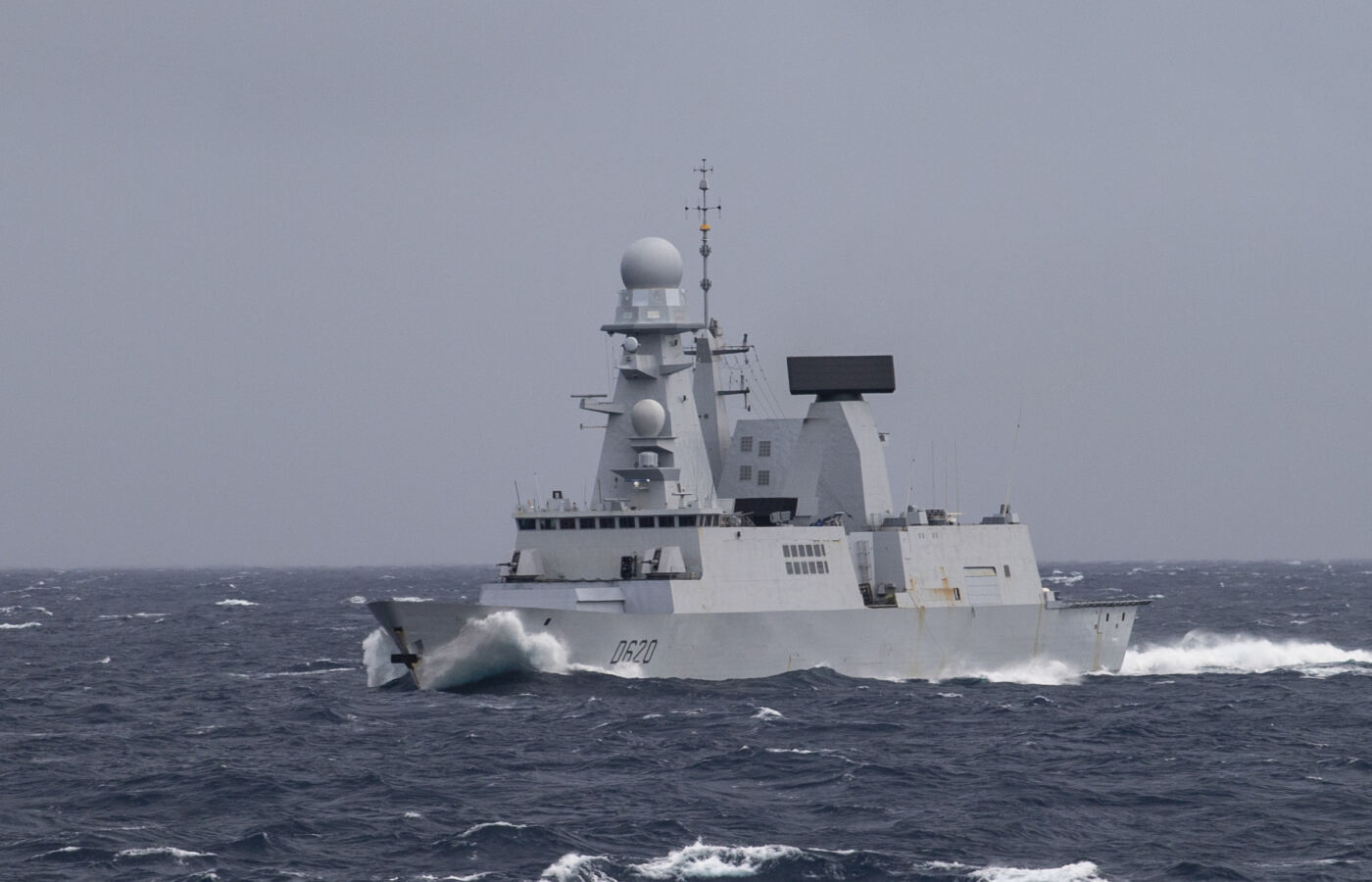
Representative photo — U.S. Navy · Mass Communication Specialist 2nd Class Kyle Carlstrom
This is a work of the U.S. federal government and is in the public domain. The use of visual materials from the Department of Defense does not imply endorsement by the Department of Defense.