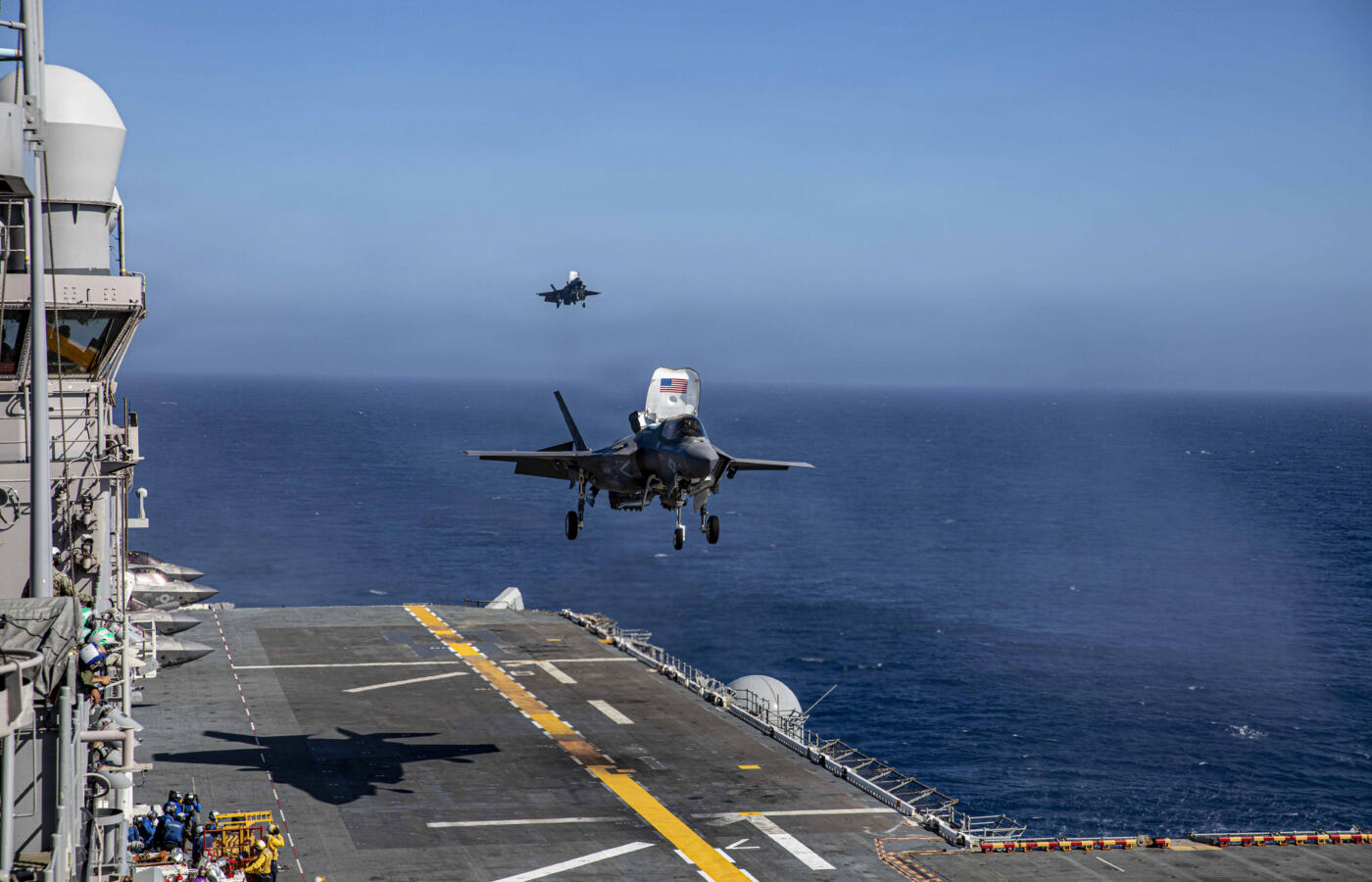
- The paradox is that to deploy 9 ships at sea, you need a total of 40 ships.
- 31 ships are not sufficient to guarantee the deployment of three task forces.
- What was revealed before the new ship was even launched was a flaw in the maintenance system.
- The return to large warships does not erase the distributed-force concept; it raises insurance premiums.
- The Marine Corps is not requesting funding for the purchase of nine ships, but rather for the insurance premiums related to their availability.
- Three things to check before looking at the numbers:
- Frequently Asked Questions.
- Are the 40 vessels part of a finalized U.S. Navy construction plan?
- How many amphibious assault ships does the United States currently possess?
- Could South Korean shipbuilding companies secure contracts for large-scale amphibious assault ships?
The paradox is that to deploy 9 ships at sea, you need a total of 40 ships.
The U.S. Navy is legally required to maintain a fleet of 31 amphibious warfare ships, but the actual combat readiness level is only 47%. The number of ships in a fleet and the number of ships that can be immediately deployed to the battlefield are entirely different things. Just as having a car in the garage does not mean you can get to work if it won’t start.
The U.S. Marine Corps and Navy have concluded that 40 amphibious warfare ships are needed to maintain a constant deployment of three Amphibious Ready Groups/Marine Expeditionary Units (ARG/MEU). This includes 13 large-deck amphibious assault ships and 27 Amphibious Transport Dock ships.
On the surface, it is an expansion plan calling for nine more ships than the current statutory minimum. However, the real meaning behind this demand is simpler and more unsettling. It means that the United States is trying to cover the costs of failing to properly repair and operate the amphibious ships it already has with nine new ships.
31 ships are not sufficient to guarantee the deployment of three task forces.
The United States’ legal requirement stipulates a minimum of 31 large amphibious warfare ships, of which at least 10 must be of the Landing Helicopter Assault (LHA) or Landing Helicopter Dock (LHD) class. Based on this requirement alone, the Navy appears to already possess the necessary framework.
However, what the Marine Corps wants is not simply the number of units, but the continuous deployment of 3.0 Amphibious Ready Groups/Marine Expeditionary Units (ARGs/MEUs). The plan is to field one Amphibious Ready Group/Marine Expeditionary Unit on each of the U.S. east and west coasts, and to forward-deploy one around Okinawa, Japan. Typically, a single unit consists of one large amphibious assault ship and two LPDs or LSDs (Dock Landing Ships), carrying a Marine expeditionary unit of approximately 2,200 personnel.
Shawn Brody, Director of Maritime Expeditionary Warfare at the U.S. Marine Corps Combat Development Command, explained the conclusion of the joint military analysis team as follows: “The joint military analysis team reached the conclusion that 40 ships are needed. This includes 13 large amphibious assault ships and 27 LPDs.”
This is not simply a revival of the previous goal of 38 ships. While the previous standard was based on the transport capacity of two Marine Expeditionary Brigades, the current standard is the ability to continuously maintain three Amphibious Ready Groups/Marine Expeditionary Units at sea, both during peacetime and in crisis situations. Even though the numbers are similar, the calculation has changed. The Marine Corps prioritizes sustained availability over transport capacity.
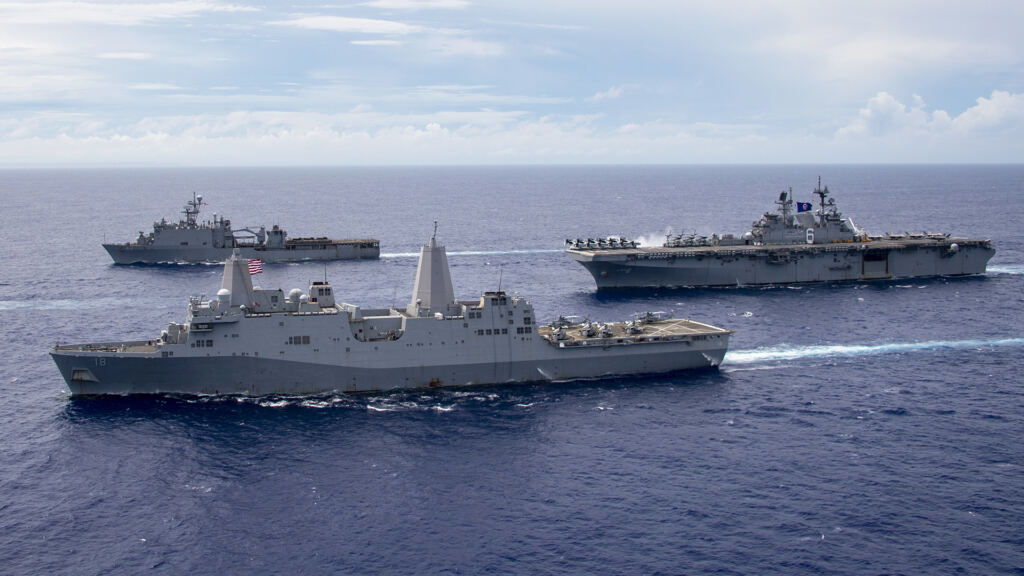
What was revealed before the new ship was even launched was a flaw in the maintenance system.
The primary justification for the request for 40 ships lies not in the sheer number of vessels, but in their low availability. The U.S. Government Accountability Office assessed that, as of March 2024, out of 32 amphibious warfare ships, 16 were in an unsatisfactory condition, with some being inoperable for several years. Furthermore, the average availability rate for training and operational purposes, as presented by the Marine Corps after June 2024, was only 46%.
In particular, the delay in the maintenance of large-deck amphibious assault ships creates a significant gap for the entire fleet. The average extension of planned maintenance for LHA (Landing Helicopter Assault) and LHD (Landing Helicopter Dock) ships is 342 days. Ships that can operate the F-35B and MV-22 aircraft from their large flight decks are difficult to replace. When one ship is tied up in the maintenance dock for an extended period, it is not simply the loss of one ship, but a complete loss of an aviation operation capability and command and control ability.
The figures presented to the Congress by James W. Kilby, Deputy Chief of Naval Operations, are more direct. “The combat readiness of surface ships is as follows: cruisers and destroyers are at 66%, amphibious warfare ships are at 47%, and the overall surface fleet readiness is 62%.” Amphibious warfare ships are particularly lagging within the Navy’s surface fleet.
Therefore, the solution proposed by Director Brody involves a combination of new construction and service-life extension. However, new ships will not arrive for several years, and service-life extension requires more maintenance capabilities. If the components, shipyard schedules, and skilled workforce remain the same, then 40 ships may not be a solution to the problem, but rather a new set of problems that simply increases the backlog of ships awaiting maintenance.
The return to large warships does not erase the distributed-force concept; it raises insurance premiums.
The force design during Burger’s tenure as Marine Corps commandant was wary of concentrating military capability on a small number of large warships under the threat of long-range precision strikes from China. Instead, he advocated for alternatives such as medium-sized landing ships (LSMs), unmanned systems, and a dispersed coastal maneuver capability.
This proposal for 40 vessels is more akin to a revised compromise than a declaration to abandon the original plan. While LSMs are useful for dispersed operations, they cannot replace the functions of large ships, such as aircraft operation, command and control, and large-scale troop transport. The Marine Corps concluded that it cannot increase the number of small vessels while abandoning large ships.
The issue is how effectively large-scale amphibious assault ships can be deployed in high-intensity, large-scale conflicts. While large ships carrying F-35B aircraft and MV-22 tiltrotor aircraft are multi-purpose platforms, they are also high-value targets that are vulnerable to China’s anti-ship missiles, surveillance and reconnaissance assets, and unmanned systems. The number 40 does not guarantee survivability. Escort forces, dispersion, deception tactics, and air defense/missile defense systems must work together for the number to translate into operational capability.
The forward deployment axis in Okinawa is also an indirect variable for South Korea. It has the potential to be used for reinforcement of the Korean Peninsula in times of crisis, transportation of non-combat personnel, and naval operations. However, this request is based on the global forward deployment needs, not on missions related to the Korean Peninsula, and its direct impact on South Korea is not significant. The main shipbuilding companies for U.S. LHA (Amphibious Assault Ship) and LPD (Amphibious Transport Dock) are HII, and there is no confirmed direct contract opportunity for South Korean companies. While the LSM (Landing Ship Medium) construction contract for Hanwha Group’s Philly Shipyard and this expansion of large-scale ships are part of the same trend of expanding amphibious capabilities, they are not automatically linked projects.
The Marine Corps is not requesting funding for the purchase of nine ships, but rather for the insurance premiums related to their availability.
I believe that this request for 40 ships is not a declaration of the strategic return of large landing ships, but rather an attempt to secure a buffer stock based on a low availability rate. The first reason is the reality that even with 31 ships, the combat surge readiness rate is only 47%. The second reason is that the Navy’s shipbuilding plan for 2026 indicates that the number of landing ships will remain at a level of 32 to 33 until 2031, and that a schedule for increasing the number to 40 has not yet been established.
The amount of money involved also supports this interpretation. If we simply assume an increase from the current 9 large warships and 22 dock landing ships to a target of 13 large warships and 27 dock landing ships, the cost of building just 4 large warships and 5 LPDs (Landing Platform Dock) is already $26,762,800,000. This figure does not include operating costs, maintenance, life extension, or inflation. The figure of 40 ships represents not only a military concept but also a long-term financial demand aimed at HII Ingalls’ production lines and the U.S. Navy’s shipbuilding budget.
If my assessment is incorrect, it will be when it is proven that the Amphibious Force Readiness Board (AFRB) has successfully addressed maintenance delays and component shortages, significantly increasing the operational readiness of the current fleet, yet the 3.0 ARG/MEU cannot be maintained. At that time, the 40 ships will not be a substitute for maintenance failures, but rather the minimum number required for actual operations.
Three things to check before looking at the numbers:
- It remains to be seen whether Admiral Kilby and Bradford J. Gering, Deputy Commandant of the U.S. Marine Corps, will present a joint proposal to the Congress in November 2026, outlining both the funding and the path for extending the ships’ service lives. Without this, the analysis will remain at the conclusion stage for the 40 vessels.
- It is necessary to confirm whether the FY2028 budget plan and the next shipbuilding plan, after the first half of 2027, include additional large ships following the LHA 11, and whether they include quantities following the LPD 36. If these are included, it would indicate a real shift in the Navy’s shipbuilding priorities.
- Starting in the fourth quarter of 2026, the quarterly reports from the AFRB should be monitored to see if there are improvements in combat readiness, maintenance delays, and the rate of securing spare parts. If these indicators do not improve, an increase in ships will not be able to fill short-term deployment gaps.
Frequently Asked Questions.
Are the 40 vessels part of a finalized U.S. Navy construction plan?
This is not the case. It is the requirement determined by the analysis organizations of the Navy and Marine Corps, and it is not a legal requirement or a finalized shipbuilding plan. Approval of funding by the National Assembly and subsequent budget allocation are necessary.
How many amphibious assault ships does the United States currently possess?
The current inventory standard for this analysis includes 9 large warships and 22 ships of the LPD/LSD class, totaling 31 vessels. However, this standard differs from the projected quantities for each fiscal year in the Navy’s shipbuilding plan, and the actual number of ships in service and those capable of conducting operations has not yet been confirmed.
Could South Korean shipbuilding companies secure contracts for large-scale amphibious assault ships?
Regarding this LHA and LPD expansion, no direct contracting opportunities for South Korean companies have been identified. The U.S. Navy’s prime contractor for building both types of ships is HII’s Ingalls Shipbuilding.
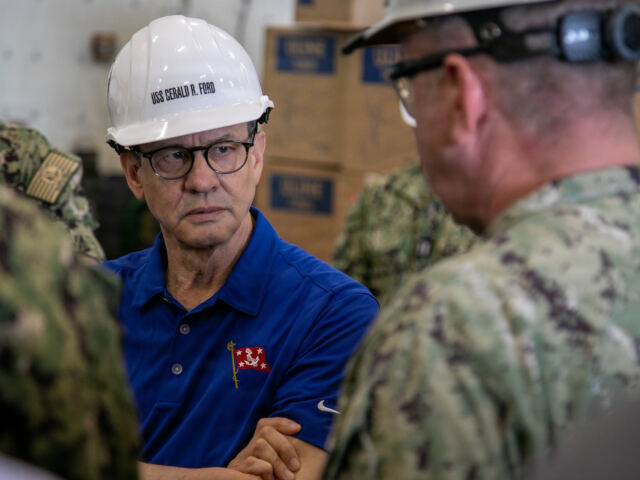
Representative photo: U.S. Navy, Mass Communication Specialist Seaman Apprentice Tomas Zuelke. Article photo: U.S. Navy, Mass Communication Specialist 3rd Class Jomark A. This is a work of the U.S. federal government and is in the public domain. The use of U.S. Department of Defense visual materials does not imply endorsement by the Department of Defense.