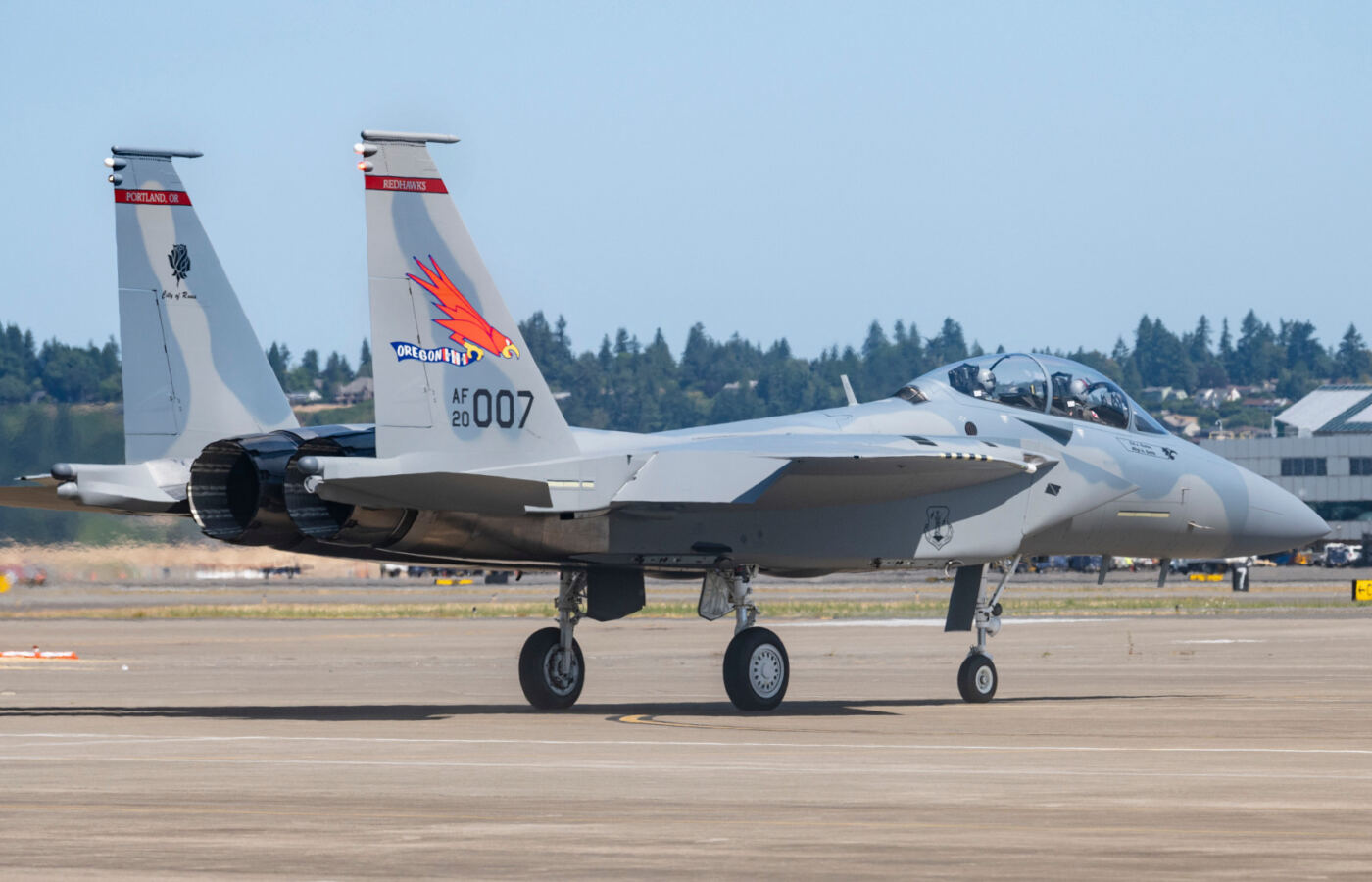
- A tank that had been excluded from the budget was attached to the side of a live-fire training vehicle.
- Two sets of CFT (Combined Forces Training) exercises revealed a regression in procurement philosophy.
- What is needed for an aircraft heading to Kadena is not speed, but loiter time.
- In South Korea, both the Gadeona and the F-15K upgrade projects face the same issues.
- The U.S. Air Force is not buying fuel tanks; it is buying time over the Pacific Ocean.
- The following three signals provide the answer.
- Frequently Asked Questions.
- What are the CFTs installed on the F-15EX?
- Has the U.S. Air Force decided to equip all F-15EX aircraft with CFTs?
- When will the delivery of the Kadena F-15EX aircraft begin?
A tank that had been excluded from the budget was attached to the side of a live-fire training vehicle.
One conformal fuel tank (Conformal Fuel Tank·CFT) holds 750 gallons. It was equipment that the U.S. Air Force initially decided it did not need to buy when it first brought in the F-15EX Eagle II. But now, two operationally deployed aircraft in Portland, Oregon, are flying with the tank attached.
A tank is not simply a fuel tank. A pair of CFTs provides an additional six pylons, allowing the space under the wings to be used for weapons. While carrying more fuel means increasing loiter time, it also means being able to stay in the air longer at greater distances and carry more missiles and bombs, which is also significant from a military perspective.
The Oregon Air National Guard‘s 142nd Wing announced that it has installed the Conformal Fuel Tank (CFT) received from the Air Combat Command (ACC) on two F-15EX aircraft and has been conducting flights with the approved configuration over the past two weeks. This marks the beginning of the F-15EX, which was initially intended as a replacement for the F-15C/D for air-to-air and homeland defense missions, undergoing revisions to its job description to become a long-range, multi-role operational capability.
Two sets of CFT (Combined Forces Training) exercises revealed a regression in procurement philosophy.
Outwardly, this appears to be a limited operational deployment involving two aircraft with conformal fuel tanks (CFTs) attached. It is not yet possible to definitively state that this is the final decision to standardize CFTs on all F-15EX aircraft in the U.S. Air Force. In reality, it has not yet been confirmed whether these CFTs are for short-term testing and training purposes, or whether they will be permanently integrated into the equipment of the 142nd Wing.
However, the flow of funds is clearer. The U.S. Air Force did not include funding for conformal fuel tanks (CFTs) in the initial operational deployment of the F-15EX in 2023. The reasoning was that, for an aircraft intended to replace the F-15C/D and perform interception and homeland defense, under-wing auxiliary tanks are simpler and cheaper than CFTs, and therefore a more cost-effective solution.
The calculation was reversed in subsequent budgets. The U.S. Air Force’s fiscal year 2027 budget included CFTs (Conformal Fuel Tank) for 24 F-15EX Lot 8 aircraft, along with related alternative-mission equipment. The procurement cost for the F-15EX is $2,656,716,000. The equipment that was initially omitted to reduce the procurement cost of the initial aircraft was later repurchased as the mission scope expanded. In military procurement, the phrase “buying it cheaply” often means delaying the payment of the invoice.
The CFT (Conformal Fuel Tank) in the photograph still bore the markings of the 366th Fighter Wing at Mountain Home Air Force Base in Idaho. It is highly likely that assets from an F-15E Strike Eagle unit were repurposed. Rather than waiting for new equipment, they began conversion training using existing assets, which indicates that the change in mission is more urgent than the acquisition of new equipment.

What is needed for an aircraft heading to Kadena is not speed, but loiter time.
The CFT operation in Portland cannot be simply viewed as a regional experiment on the mainland. The 142nd Fighter Wing conducted the first training bomb drop by an F-15EX at Mountain Home in May 2026, and subsequently conducted live bomb drop training at Nellis Air Force Base. The same aircraft is moving toward performing not only air-combat alert duties but also air-to-ground missions.
A potential destination for this change is Kadena, Japan. The U.S. Air Force plans to deploy 36 F-15EX aircraft to Kadena Air Force Base as a permanent replacement for the retired F-15C/D aircraft, with the first aircraft expected to arrive in fiscal year 2027. The value of fighter aircraft at a forward base close to China is not determined solely by maximum speed. A more valuable capability is how long they can remain airborne, and how much ordnance they can carry to continue missions, especially when tanker support and base operations are limited.
CFT (Conformal Fuel Tank) meets that requirement, but it comes at a cost. Unlike auxiliary fuel tanks that can be jettisoned during flight, CFTs cannot be discarded, which limits maneuverability in close-range aerial combat. The F-15EX, being a non-stealth 4.5-generation platform, cannot replace the F-35A in penetrating high-threat air defense networks. What the U.S. Air Force needs is not an all-purpose fighter, but rather a large missile/strike platform that can operate for extended periods within the space opened up by stealth aircraft and carry a significant payload.
The problem lies in production. The Boeing St. Louis factory strike delayed the delivery of the F-15EX aircraft, and the schedule for the permanent deployment to Kadena Air Base has been pushed back from the spring of 2026 to the 2027 fiscal year. The U.S. Air Force signed a contract for Lot 7, 22 aircraft, for $2,380,000,000 in September 2026, but also acknowledged the burden of production disruptions and defense industry inflation. The capabilities of an aircraft are not realized solely on the runway; they require supporting production lines and maintenance facilities.
In South Korea, both the Gadeona and the F-15K upgrade projects face the same issues.
The direct variable for South Korea is not the two aircraft from Oregon, but the 36 aircraft from Kadena. If the Kadena F-15EX aircraft are configured with CFTs (Conformal Fuel Tanks) for long-range air-to-air and air-to-ground missions, it will change the U.S. Air Force’s airborne and strike capabilities in the Western Pacific, which is adjacent to the Korean Peninsula. While this flight itself does not necessarily mean deployment to the Korean Peninsula, the initial operational configuration of the Kadena aircraft will also represent a practical change in operational environment for the Korean Air Force.
South Korea is pursuing an upgrade to the F-15K Slam Eagle (F-15K Slam Eagle). The provisional foreign military sales amount approved by the U.S. government is $6.2 billion, while the total project cost set by the Defense Acquisition Program Promotion Committee is approximately 636.4 billion won. As the F-15EX’s mission systems and maintenance ecosystem expand, the long-term logistics commonality of the F-15K upgrade will also be affected.
There are also industrial connections. Hanwha Systems has a contract to supply large cockpit displays for the F-15K and F-15EX aircraft to Boeing, and Hunid Technologies has announced a contract to supply avionics equipment for the F-15EX. However, interpreting this as a signal for the ROK Air Force to adopt CFTs is an exaggeration. The fact that CFTs are being introduced to the F-15K or that it is being converted to an F-15EX-type CFT configuration has not been confirmed in this matter.
The U.S. Air Force is not buying fuel tanks; it is buying time over the Pacific Ocean.
The author views this CFT (Conformal Fuel Tank) flight not merely as a simple equipment test, but as a preliminary step to shift the F-15EX’s mission focus from homeland interception to long-range, multi-role operations in the Pacific. First, even in the early operational phase when there was no CFT budget, assets from the 366th Fighter Wing were brought in and installed. Subsequently, the CFT was re-included in the Lot 8 budget. Second, the timing of the Oregon unit’s training, which included the dropping of training bombs and live bombs, coincides with the preparations for deployment to Kadena.
The U.S. Air Force’s target fleet size is 267 aircraft. This number indicates that the intention is not to simply replace F-15C/D models with the F-15EX. To also modernize a portion of the older F-15E fleet, interceptor capabilities alone are insufficient. CFTs (Conformal Fuel Tanks) are not primarily about increasing range; they represent a strategic choice regarding which aircraft will be deployed to which segment of a conflict.
If my assessment is incorrect, it is likely because this current installation is not a preliminary measure for Kadena and follow-on production, but rather ends with a short-term rental of two sets of equipment, and because the plans for CFT modification and procurement for existing deliveries and the Kadena deployment will not follow. Therefore, the next budget and the arrival of the first Gadena aircraft are more important than words.
The following three signals provide the answer.
- From November 2026 to 2027, it is necessary to confirm whether the budget for Lot 8 of the CFT (Conformal Fuel Tanks) and the existing F-15EX modification, as stipulated in the 2027 fiscal year defense appropriations and the National Defense Authorization Act, will be finalized. If finalized, this would mean that the temporary operation will transition to a fleet-wide transition.
- Whether the first F-15EX aircraft to arrive in Kadena during the 2027 fiscal year is equipped with CFTs (Conformal Fuel Tanks) is a key indicator. If it is equipped with CFTs, it means that the long-range, multi-role capability of the forward-deployed force is incorporated from the initial configuration.
- Over the next few months, it is necessary to confirm whether the number of aircraft equipped with CFT (Conformal Fuel Tank) increases within the 142nd Wing, and whether integrated training involving live ammunition, anti-ship missiles, and long-range missiles continues. This will indicate whether the purpose of the CFT is simply to increase fuel capacity or to expand the aircraft’s payload.
Frequently Asked Questions.
What are the CFTs installed on the F-15EX?
This is a fuel tank that is mounted close to the aircraft’s fuselage. A single CFT can carry 750 gallons, and a pair provides an additional 6 pylons.
Has the U.S. Air Force decided to equip all F-15EX aircraft with CFTs?
It has not yet been confirmed. The U.S. Air Force has equipped two aircraft from the Oregon 142nd Fighter Wing with CFTs (Conformal Fuel Tanks) provided by ACC (Air Combat Command), and the CFTs are included in the budget for fiscal year 2027, Lot 8.
When will the delivery of the Kadena F-15EX aircraft begin?
The U.S. Air Force announced that F-15EX aircraft are scheduled to arrive at Kadena Air Base starting in the 2027 fiscal year. The planned permanent deployment includes 36 aircraft.
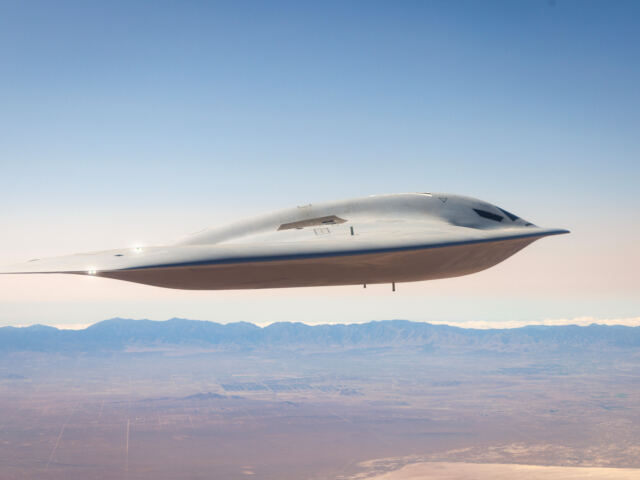
Representative photo – U.S. Air Force · USAF
Body photo – U.S. Air Force · Bill Shemley
This is a work of the United States Federal Government and is in the public domain. The use of visual materials from the Department of Defense does not imply endorsement by the Department of Defense.