- Lasers under palm trees, Stingers over the sea.
- While it may seem like the laser is the main focus, the operation is actually a joint effort.
- First, before addressing the issue of hitting the target, the authority over civilian airspace must be resolved.
- Presidential security will be the most expensive real-world demonstration of environmental control technology.
- In my opinion, the goal of this deployment is to normalize domestic operations rather than to achieve shootdown records.
- The next signal comes from documents, not from equipment photos.
- Frequently Asked Questions.
Lasers under palm trees, Stingers over the sea.
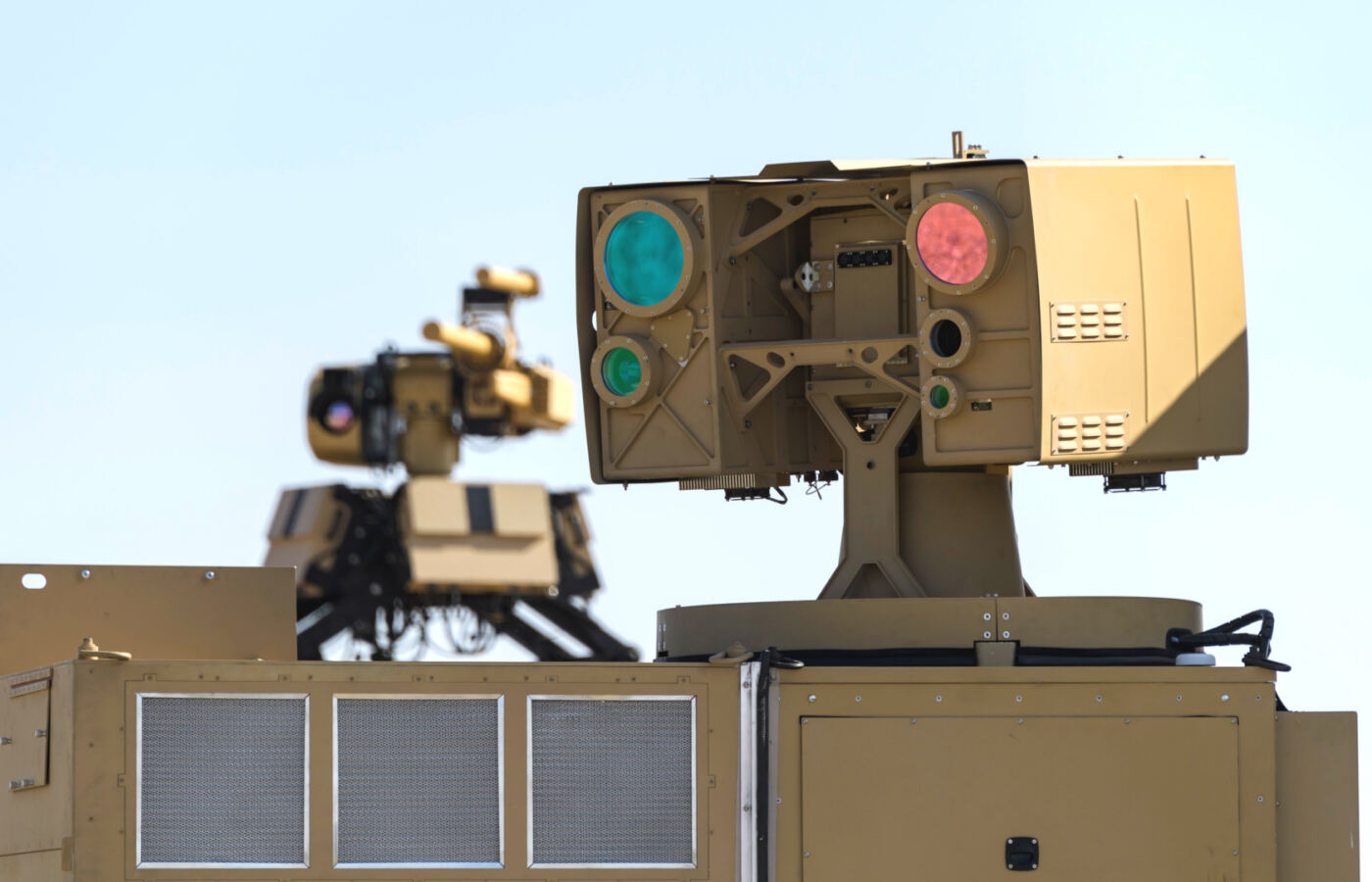
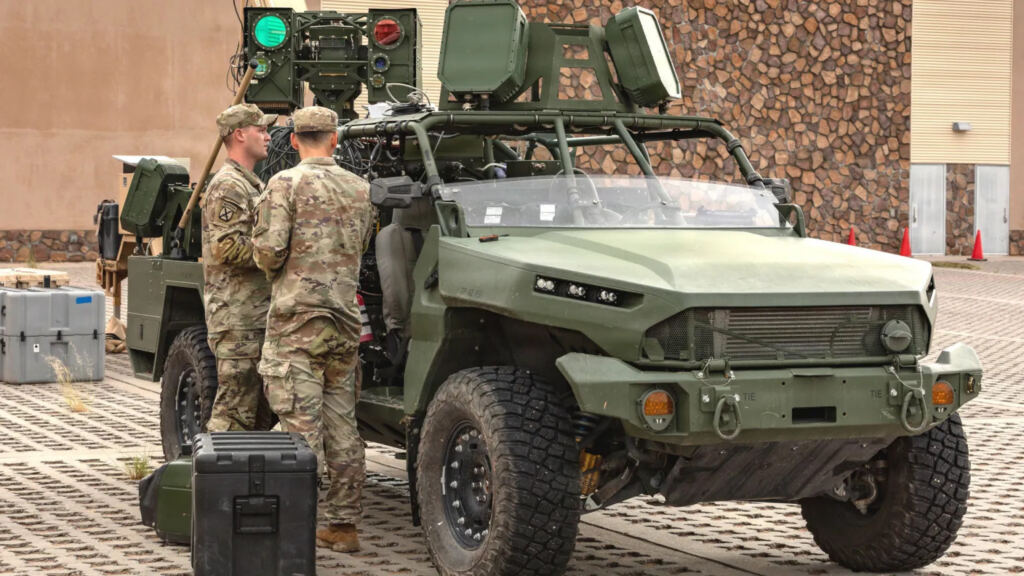
Between the palm trees, a laser weapon was positioned next to a Joint Light Tactical Vehicle (JLTV). On the floating platform in Lake Worth Lagoon, two AN/TWQ-1 Avenger short-range air defense systems, each equipped with Stinger missiles, were deployed. This image shows a scene where radar, jammers, infrared sensors, missiles, and lasers are all captured in a single frame to counter a single drone.
Although lasers are weapons that are not easily visible, this time, a photograph spoke first. A photograph taken on October 31, 2026, confirmed that a piece of equipment identified as the AeroVironment LOCUST Laser Weapon System was deployed near the Mar-a-Lago estate of President Donald Trump.
In response to a request for support from the U.S. Secret Service (USSS), the North American Aerospace Defense Command (NORAD) and the U.S. Northern Command (USNORTHCOM) deployed a counter-unmanned aircraft system (C-UAS) in a joint operation. While domestic reports focused on the “Avengers” and the Iranian threat, the key point is that the presidential security site became a testing ground not for the performance of lasers, but for establishing operational procedures for defending the U.S. mainland against drones.
While it may seem like the laser is the main focus, the operation is actually a joint effort.
Outwardly, the LOCUST, a 20~35+ kilowatt-class system (30 kilowatts according to the manufacturer), appears to be a next-generation defensive weapon designed to replace missiles. The promise of lasers to reduce the per-shot cost and reload burden is also clear. However, the arrangement in the photograph is not a declaration of the superiority of laser-only defense, but rather an admission that it is insufficient on its own.
The Avenger system carries four Stinger missiles on each of its two launchers, and is designed to counter low-altitude aircraft and complex threats. In contrast, the LOCUST is primarily focused on small to medium-sized drones. The anti-drone flyer kit sent by the U.S. Northern Command may include a Ku-band radar, electronic support measures (ESM), electronic warfare jammers, and electro-optical/infrared detection equipment. Lasers cannot fire unless they detect a target, and their performance is also affected by weather conditions, humidity, fog, dust, vibration, and cooling. While lasers are fast, they are not a universal solution.
The U.S. Army defines the Enduring-High Energy Laser (E-HEL) as an element of a layered defense system that combines sensors, electronic warfare capabilities, and kinetic interceptors. While lasers with a power output of 100 kilowatts or more are designed to defend against cruise missiles, rockets, and mortar rounds, this 30-kilowatt-class family is intended for lower-altitude and slower drone threats. This is not a competition between missiles and lasers, but rather a division of labor that determines which targets to address at what cost.
This issue also presents an indirect challenge for South Korea. South Korea has been operating the Cheongwang (Laser Based Anti-Aircraft Weapon Block-I) since the end of 2024, and South Korea has proposed launching research and development for the mobile Block-II system. However, there is no evidence to suggest that the deployment at Mar-a-Lago is related to operations on the Korean Peninsula or joint procurement between South Korea and the United States. The relevant comparison should focus on sensor integration, engagement procedures, and methods for coexistence with civilian airspace, rather than on power output specifications.
First, before addressing the issue of hitting the target, the authority over civilian airspace must be resolved.
The most challenging target for anti-drone lasers may not be the drones themselves. Mar-a-Lago is located approximately 3 miles from the Donald J. Trump International Airport, and there have been over 160 instances of aircraft and drone intrusions into the no-fly zone surrounding the presidential residence since October 2025. This area is a place where security vulnerabilities cannot be tolerated, yet where civilian air traffic cannot be halted.
The United States has already borne these costs. In February 2026, the LOCUST operation near El Paso caused the airport airspace to be closed for approximately 7 hours, bringing the coordination issues between the FAA and the Department of Defense to the forefront. Two months later, the Federal Aviation Administration completed a safety risk assessment and signed an agreement for the operation of laser systems within domestic airspace. Brian Bedford, Administrator of the FAA, stated, “Following a thorough and data-driven safety risk assessment, we determined that these systems do not pose an additional risk to general aviation users.”
Here, the price of the technology and the price of the system are different. It is a simple calculation that a missile does not have to be used for each target. On the other hand, the issues of who identifies the target, who authorizes jamming or laser use on which flying objects at which stage, and who notifies airports and security agencies of the interruption are much more expensive and time-consuming. Even if a beam travels at the speed of light, the approval process does not.
In this deployment at Mar-a-Lago, the exact model and performance specifications of the LOCUST, the operating unit, rules of engagement, deployment period, and whether live firing exercises were conducted have not yet been confirmed. NORAD and the U.S. Northern Command acknowledged the deployment of air defense and counter-UAV assets, but did not officially mention the LOCUST itself. This omission may be due to operational security concerns, but it also suggests that the practical standards for domestic laser operations have not yet been publicly established.
Presidential security will be the most expensive real-world demonstration of environmental control technology.
AeroVironment announced in September 2026 that it had signed a $464.8 million Other Transaction Authority contract with the U.S. Army for the production of the E-HEL. The U.S. Army described it as the first production contract for a high-energy laser weapon. Two months later, equipment from the same family appeared as part of the security detail at the president’s private residence.
This scene provides a strong operational reference for the company. However, the impressive figures in the contract should not be directly translated into immediate mass production success. The U.S. Army’s FY2026 budget includes $49,750,000 for the procurement of up to 2 E-HEL units, but the exact contract quantity, mandatory expenditure amount, per-unit price, and delivery schedule have not been disclosed. The $464,800,000 figure is the manufacturer’s stated value, and is not a finalized delivery invoice.
Reliability is still a challenge at the production stage. Kirk Williams, chief engineer at the U.S. Army’s Directed Energy Program Office, said, “What needs to be done now is to make these systems reliable enough that soldiers can trust and use them when they need them.” The U.S. Northern Command’s announcement that a high-energy laser destroyed 11 cartel-linked drones during border security operations from August 24 to September 4, 2026, is a clear operational track record. However, that does not mean the laser has been validated in the complex airspace around Mar-a-Lago.
In my opinion, the goal of this deployment is to normalize domestic operations rather than to achieve shootdown records.
The author believes that the deployment of the LOCUST system at Mar-a-Lago is not about showcasing specific equipment, but rather an effort to integrate military lasers into the U.S. domestic security and airspace system. First, after the El Paso airspace closure, the FAA and the Department of Defense signed a safety agreement, and then lasers were deployed near the presidential residence adjacent to the airport. The sequence for technology is prototype development, combat use, and mass production, but for domestic operation, the sequence is closer to safety evaluation, inter-agency authority adjustment, and deployment for high-visibility missions.
Secondly, this field deployment does not only involve lasers, but also includes missiles, jammers, and radars. This approach aims to integrate the LOCUST system as a standard component of homeland defense, rather than selling it as a standalone solution. Presidential security is a mission where even the smallest error can result in significant political repercussions. Operating experience gained here can provide justification for expanding these rules to areas such as airports, stadiums, and critical infrastructure.
If my assessment is incorrect, it is likely that this deployment was a short-term response to a specific, imminent threat that was not related to the institutionalization of domestic operations, and that the deployment and operational criteria for LOCUST were not extended to other facilities as a result. Currently, it has not been confirmed which of the following was the direct cause of the deployment: the threat from Iran, the threat of domestic assassination, the midterm elections, or the violation of the no-fly zone.
The next signal comes from documents, not from equipment photos.
- It remains to be seen whether NORAD, the U.S. Northern Command, or the Secret Service will disclose details about the LOCUST model, the unit that operates it, its deployment period, and its authority to engage in combat, either immediately after the midterm elections or before or after Trump’s stay at Mar-a-Lago. If such information is disclosed, it would indicate that the operational framework is becoming more concrete, going beyond temporary support.
- In the short term, the key factors are whether there is an actual announcement of an unmanned aerial vehicle interception near Mar-a-Lago, whether the FAA issues a flight safety notice, and whether any accident reports are filed. This will be the first data to confirm the distance between the deployment and any actual engagements.
- It is necessary to verify whether the original E-HEL contract, the confirmed allocation, the exercise of options, the initial delivery, and the results of the acceptance tests by the Army will be made public between the end of 2026 and 2027. This will determine whether the $464.8 million reflects a genuine move to production or is merely a broadly defined contract limit.
Frequently Asked Questions.
Questions Did the LOCUST system deployed at Mar-a-Lago actually shoot down an actual drone?
There has been no official confirmation that the LOCUST system engaged or destroyed actual targets in the vicinity of Mar-a-Lago.
Question: Is the laser in the photo the 30-kilowatt LOCUST X3?
The exact model and output of the system mounted on the JLTV in the photograph have not been confirmed by the government. The publicly stated output rating for the LOCUST X3 is 20 to 35+ kilowatts, and the manufacturer describes the system for the E-HEL as being in the 30-kilowatt range.
Questions: Which is stronger, the Avenger or the Laser?
The two systems have different missions. The Avenger is responsible for short-range air defense, including aircraft, using Stinger missiles. The LOCUST is a high-energy laser system primarily designed to counter small to medium-sized drones.
Main image: U.S. Army.
Body image: U.S. Army.
This is a work of the United States Federal Government and is in the public domain. The use of visual materials from the U.S. Department of Defense does not imply endorsement by the Department of Defense.